



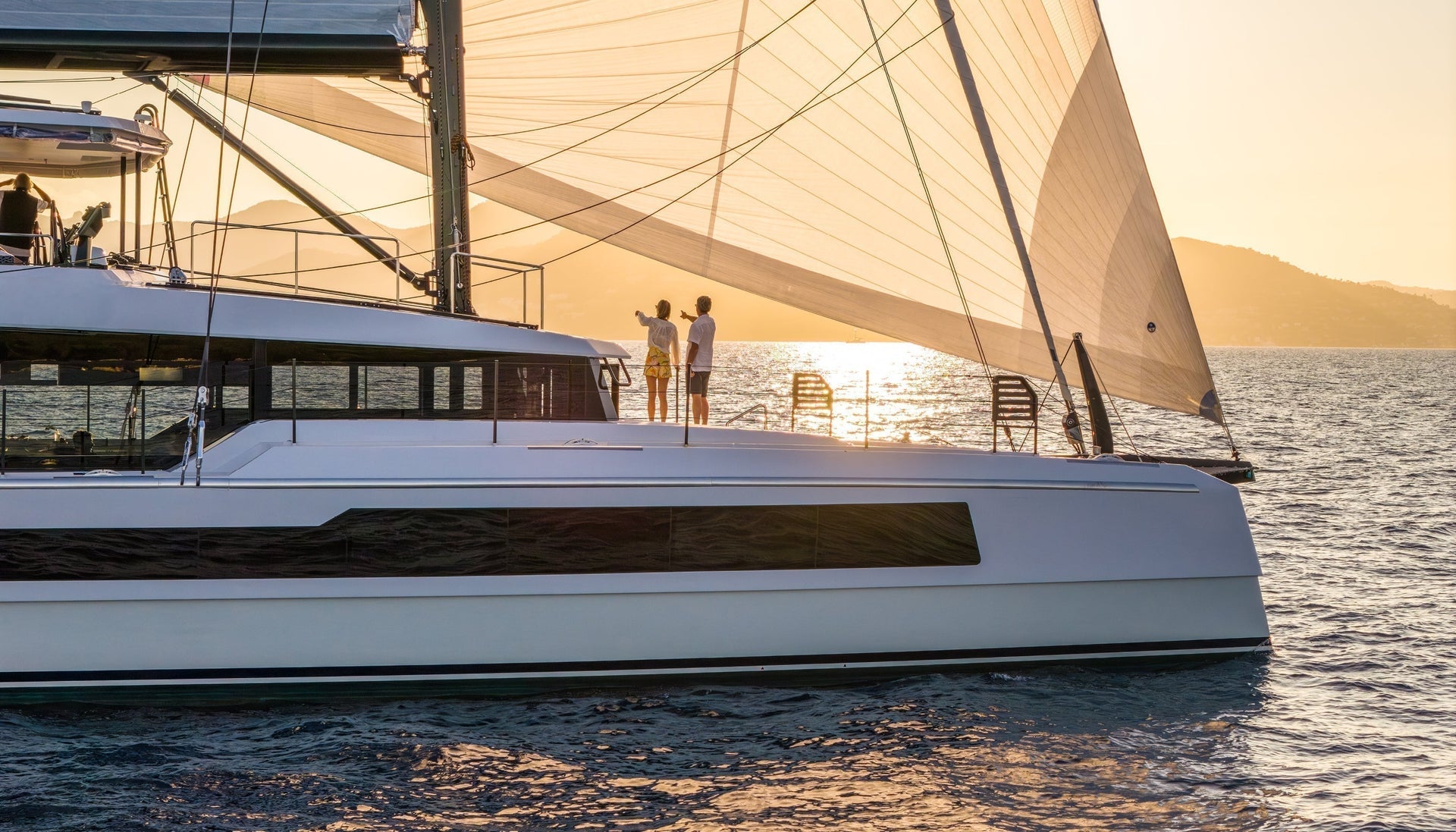
FREE-FLYING FURLING SAILS FOR CRUISERS: WHAT YOU NEED TO KNOW
Your guide to understanding modern free-flying furling sails.
A free-flying furling sail, like a cruising code zero or furling gennaker, adds convenient light-wind power to a cruising inventory, but should be handled within certain parameters to enjoy stress-free sailing.
FLYING HEADSAILS EXPLAINED
Sail designers can shape free-flying headsails to serve a variety of needs. Shapes can range from a flat, triangular, genoa-looking "screecher" on a performance multihull, to a large, round, and deep-downwind furling gennaker. These sails are differentiated by larger girths—especially in the middle and top—and by their three-dimensional roundness.

This diagram illustrates how a sail progresses from a flatter 50% mid-girth sail for tight reaching, to a deep, 100% mid-girth sail for broad angles, and anywhere in between. Lately, modern cruising shapes like North's Helix Furling Gennaker offer a wide range of wind angles, from as tight as 70 degrees of apparent wind angle in flat water, to 130AWA or even lower with a reefed mainsail. But changes in sail shape and dimension also affect the way the sails furl, and understanding this relationship is key to effortless furling.
BOTTOM-UP FURLING: SIMPLE, WITH NUANCE
Bottom-up furling is the most common setup for cruising Code Zeros and smaller flying headsails. In this configuration, the sail furls from the tack upward. When you pull the continuous furling line, it rotates the drum at the base of the furler, which in turn twists the bottom end of the luff cable and begins to wrap the sail from the bottom. This is a straightforward process, but it brings with it certain behaviors you need to understand.
As the tack begins to roll in, the foot of the sail gets tighter, and the clew is pulled forward. This changes the angle of the sheet as the furl progresses, most especially for sails with relatively low clews. When the sheet angle starts to drop, the downward pull on the leech diminishes. This reduced leech tension can be problematic, particularly in sails with a large roach (relatively more area in the top of the sail). If the top of the sail doesn’t have adequate tension during furling, it can roll loosely, leaving gaps between the outer edge of the furl and the layers inside. This gives an opening for high winds to grab the sail cloth, and prolonged exposure can peel open loose furls at the head, catching more wind and threatening to partially or completely unfurl the sail.
You can mitigate these challenges by deflecting the sheet down when furling, sometimes by hand on smaller boats, or with a barber hauler/twing setup on larger boats. By tensioning a twing in front of the sheet point, you can add downward force on the clew during the furl to maintain leech tension, improving the likelihood of a tight, clean roll.

TOP-DOWN FURLING: BETTER CONTROL FOR BROADER SAILS
As sails get wider and deeper in the head, especially if they also have low clew, bottom up furling systems can't secure the fabric in the top third of the sail well, even if a proper sheet angle is maintained -- there's just too much fabric to lie snug when the furl comes from the tack. This is when top-down furling systems come to the rescue. Typically used for asymmetrical spinnakers and wide-girth cruising gennakers, these systems start the furl from the top, by allowing the tack of the sail to remain independent of the spinning bottom end of the cable. The tack is lashed to a new component, a tack swivel (sometimes called a “top-down adapter”), mounted between the sail and the furling cable. When you pull the furling line, the cable begins to rotate inside the tack swivel, while the swivel ring -- and the tack lashing connecting the sail to it -- remains stationary. This allows torque to travel up the cable, where it initiates the furl at the head of the sail while the tack remains in place. As the furl continues, the sail then rolls from the “top down,” with the foot and clew furling last. This method allows for better control of the broader sections of the sail in the head, where excess material can otherwise cause problems.
However, this system demands that the tack connection remains passive during the early stages of furling. The tack must not begin to spin until at least the top third to half of the sail is furled. If the tack lashing catches on the cable hardware at the bottom, it will start turning too early and can cause the sail to back-wind or twist unevenly, making the furl unreliable and potentially difficult to unroll. To prevent this, make sure there's no way the tack lashing can catch on the cable thimble or associated hardware at the bottom. Fortunately, high-quality cables like Future Fibres or torque-rope hardware that don't grab the tack lashing prevent premature engagement.

BIG PICTURE: OPERATIONAL AWARENESS AND SAFTEY
Powerful flying sails provide greater benefits in cruising performance and easier handling than traditional systems, but the convenience of leaving these sails up and furled, ready to deploy, is limited by some realities of weather and physics. A furled sail is not a stowed sail, and a sail furling on an internal cable is not as secure as your genoa on a permanent stay, where an aluminum extrusion rotates the entire luff evenly. As explained, a loosely furled sail can catch the wind and unfurl partially or entirely. A loose or stretchy halyard can allow the sail to bounce around violently when underway, distracting the operator and adding wear and tear to the halyard and gear. An unsecured continuous furling line can accidentally release the drum and unspool the whole sail. And as we know, any of these things is likely to happen at the worst possible time. For reasons like this, it is strongly recommended that you take the sail down if you know you're not going to use it, such as when traveling upwind for a while, when inclement weather threatens, or leaving the boat unattended.
There are various methods to secure a furl once it’s rolled, though none are foolproof. Wrapping the sail multiple times with the sheet, adding a velcro closure at the clew (which comes standard with North Sails), employing a ratcheting furler, or even using a soft shackle to immobilize the furling drum are all valid strategies. Still, none of these will prevent a poorly furled head from catching wind and starting to unwrap. The best solution remains a tight, clean furl and, when in doubt, taking the sail down entirely. As a relatively light sail in a compact furled package, they are the easiest sails on your boat to remove or install, and taking advantage of this benefit will prolong the life of your sail.

FURLING QUICK REFERENCE GUIDE
When Un-Furling:
- Make sure the sail is fully hoisted and there is sufficient halyard tension
- Have the sheet on a winch to control the sail as you unfurl it
- Monitor the furling line, occasionally manipulating the furling line as well as the sheet will induce a smoother unfurl
When Furling:
- Turn to a deep downwind angle to reduce apparent wind speed and alleviate pressure on the sail and rigging
- Ensure that there is adequate halyard tension. Loose cables don’t transmit torque well and can hockle
- Ease the sheet generously as you furl the sail. Unlike a genoa on a fixed headstay, sheet tension has a much greater effect on free-flying sails and will severely reduce the effectiveness of your continuous furler if not properly ease
- Monitor the furler and top swivel to confirm that parts that should move are moving and parts that should not are stationery
- For sails with a UV cover, monitor the leech and foot to confirm that the UV cover is laying on the exterior of the furl
Furling flying sails can transform your cruising experience, offering better speed and easier handling in a wide range of conditions. With a little understanding and a few simple habits, these sails quickly become powerful and convenient tools that enhance your experience. Knowing how bottom-up and top-down furling systems behave will help you sail with more confidence, safety, and enjoyment. When in doubt, furl tight, drop early, and don’t hesitate to check in with your local North Sails expert. We’re always happy to help you get the most from your inventory.