


NORTH SAILS BLOG
All
Events
Guides
News
People
Podcast
Sustainability
Tech & Innovation
Travel & Adventure
NAVIGATING THE SYDNEY-HOBART
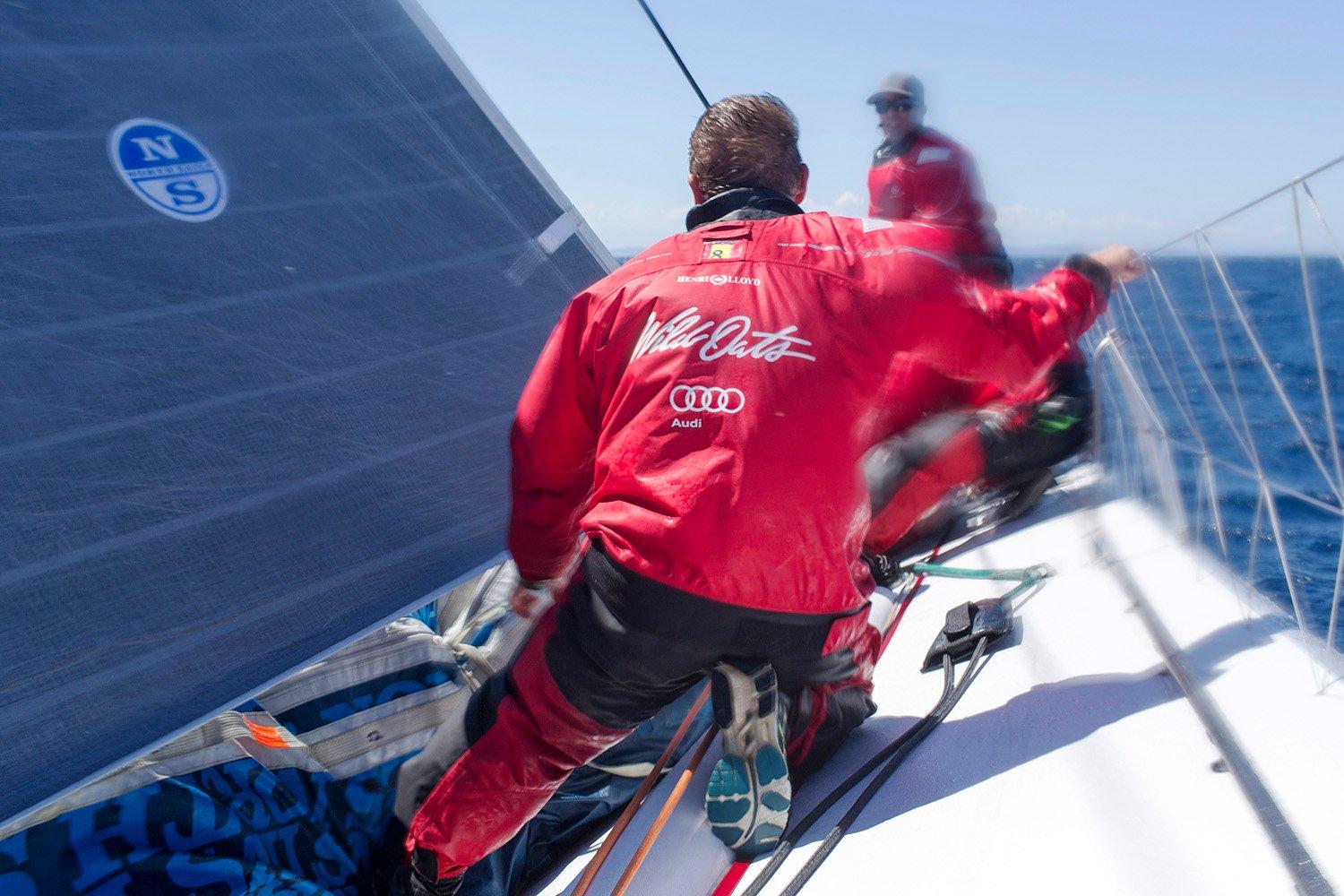
The Rolex Sydney-Hobart Race is one of the classic yachting events on the annual race calendar, arguably the most famous and difficult race taking place in the Southern Hemisphere. Its reputation is well deserved, giving all who enter it numerous challenges – not only in the level of competition the race draws, but also with many hurdles brought by Mother Nature. These environmental challenges take the form of fast changing and often strong winds, squalls, complex ocean currents, and potential for extremely rough, boat-breaking sea conditions. All that on top of what is often a more than 20 degree Celsius drop in air temperature from balmy Sydney to cool Hobart.
Navigators of the race watch typical wind patterns of the Australian summer: a semi-permanent high pressure to the east over the Tasman Sea, and another over the Great Australian Bight west of Tasmania. Air flows anti-clockwise around these high pressure systems, which means there is a tendency for northerly winds off the Sydney coast and southerly winds west of Tasmania. Between these two high pressure areas there is normally an extension of the thermal low pressure from the hot interior of Australia, extending into NSW and pointing toward the Bass Strait.
The pattern described above represents the average – that is, what you get if you average the weather maps over a long period of time in the Australian warm season. However, the actual weather on any given day is the result of modulations on the average pattern and disturbances (weather systems) embedded within the larger scale.
SOUTHERN OCEAN CHILL
“Being ready to weather strong upwind sailing and very rough seas in the wake of a S’ly change are a must for any crew and boat taking on this race.”
One such important and common disturbance involves the northward intrusion of cold air out of the Southern Ocean. When cold air pushes north toward Tasmania, the Bass Strait, and southeastern Australia, some very abrupt and severe changes can result. Ahead of the cold fronts which mark the leading edge of a cold push, winds typically build from the north along the coast. Sometimes thunderstorms can develop over the hot interior of NSW and move east into the course from Sydney and south to Green Cape. Such storms have generated spectacular waterspouts on the course – an encounter with which is not only memorable, but potentially very dangerous.
As a cold front moves north and east across the race route, fast running conditions down the coast abruptly change to hard, very rough, upwind conditions. Not to mention the fact that squalls and much cooler air make sailing more difficult. These post-change encounters are a make or break point for some teams. Being ready to weather strong upwind sailing and very rough seas in the wake of a S’ly change are a must for any crew and boat taking on this race.
TRICKS OFF TASMANIA
Further down the track from crossing the Bass Strait to east of Tasmania, winds are no less challenging. Large ocean swells are common crossing the strait, and Gale or Storm force winds can occur – especially in the day or two following a front. Off Tasmania, winds can run the gambit from strong to exceedingly light. One certainty of sailing off Tasmania is that the wind will change. The weather patterns there are fast moving and can behave erratically. An area of no wind can exist within hundreds of meters of gale force gusts. Understanding how conditions will change and making a correct call at the last moment can make the difference in almost any team’s race.
SURF OR SWIM
Another important factor in the strategies for this race is often the East Australian Current (EAC). The EAC is a western boundary current similar to those found on the east coasts of most continental land masses around the world (Gulf Stream off North America; Brazilian Current off South America; Agulas Current off South Africa, and; the Kuroshio off Asia). The EAC is a generally south-flowing current off the coast, typically extending from north of Sydney to the Bass Strait and off the east coast of Tasmania. While the current is always present in one form or another, its speed and position relative to the course can vary significantly. In addition, tight swirls or eddys are typically present in proximity to the main current flow, and can result in areas of rotating water over ten miles wide, often delivering the opposite of what a skipper may expect.
While the current doesn’t change much on a day-to-day basis – unlike the weather – it does vary over a period of weeks. Sometimes it is close to the coast and within reach of the fleet to take advantage of its southward flow. Other times, it is further offshore, and sailing out to it can be a gamble whether or not the favorable flow will be enough to offset the extra distance necessary to get to it.
There is also a potential significant downside to being in the current – even if it is within reach. When winds are blowing from the south, very large and steep waves can develop within the EAC which can, at a minimum, slow progress or, in the worst case, be boat-breaking. Anytime there is a southerly change and strong upwind conditions in this race, sea state within the EAC is a significant factor.
The crews will be closely monitoring the weather forecasts and EAC condition in the days leading up to the race. While the forecasts can be reliable, it is often the small differences that are more difficult to predict. That will combine with the level of seamanship on-board to determine how well a team does. Having a fast boat is, of course, a bonus, but being ready and able to handle whatever the weather and sea brings will make the difference.
Chris Bedford is a well known sailing meteorologist and has advised many professional teams on inshore and offshore race routing, including the Abu Dhabi Ocean Racing 2014-2015 Volvo Ocean Race team. Read more from Chris at sailwx.com
All images credit Andrea Francolini Photography | afrancolini.com
READ MORE
READ MORE

2015 TRANSAT VICTORY LIST
Recounting the year in sailing, clients of North Sails claimed 13 podium places in the 2015 collection of Transatlantic Races. Once again bringing North to the forefront, offshore teams displayed ultimate success with 3Di sails on a range of different platforms, winning 12 out of 15 total classes. After entering the racing sail market in 2010, North’s 3Di product is now optimized for coastal and offshore cruising. Between the classic Newport – Lizard course, the Transat Jacques Vabre, RORC Transatlantic Race and most recently the Transat St. Barth, North-powered boats claimed podium places at every finish. Coupled with the successful circumnavigation of six Volvo Ocean Race teams, and the crushing pace of current Jules Verne contenders IDEC Sport and Spindrift Racing, these following results are a testament to the unmatched performance and durability of North Sails 3Di.
TRANSATLANTIC RACE 2015
(NEWPORT TO LIZARD)
IRC Overall
1 – Lucky
2 – Outsider
IRC 1 Racing
1 – Rambler 88
2 – Comanche
IRC 2 Racing
1 – Lucky
2 – Outsider
“The 3Di sails have really been a game changer on the catamaran…they have transformed the performance of our boat. We’ve also witnessed a big step forward under durability, and decided to convert to 3Di screechers as well.” – Lloyd Thornburg, owner/driver of Phaedo3
IRC 3 Racer/Cruiser
1 – Snow Lion
2 – Maximizer
3 – Prospector
IRC Class 4 – Racer/Cruiser
2 – Dorade
Class 40
1 – Stella Nova – (North Sails mainsail)
Open
1 – Paradox
2 – Phaedo 3
Monohull First to Finish: Comanche
Multihull First to Finish: Phaedo3
TRANSAT JACQUES VABRE
(LE HAVRE TO ITAJAI)
Ultime
1 – Macif
2 – Sodebo Ultim’
IMOCA
1 – PRB
2 – Banque Populaire VIII
3 – Quequiner – Leucémie Espoir (except mainsail)
Multi50
2 – Ciela Village
Class40
1 – Le Conservateur
“I am at the nav table on Sodebo and as I looked up out of my window at my mainsail I was thinking: this is the most beautiful mainsail I have ever had.” – Thomas Coville, co-skipper of Sodebo Ultim’
RORC TRANSATLANTIC RACE
(LANZAROTE TO GRENADA)
IRC Overall
1 – Nomad IV
MOCRA Multihull
1 – Phaedo 3
2 – Concise 10
3 – Zed 6
Class40
1 – Tales II
2 – Silvie Belle 2
First to Finish Monohull: Nomad IV
First to Finish Multihull: Phaedo 3
TRANSAT ST BARTH – PORT LA FORÊT
IMOCA only
1 – Edmond de Rothschild
READ MORE
READ MORE
MELGES 32: ARGO'S WINNING STREAK
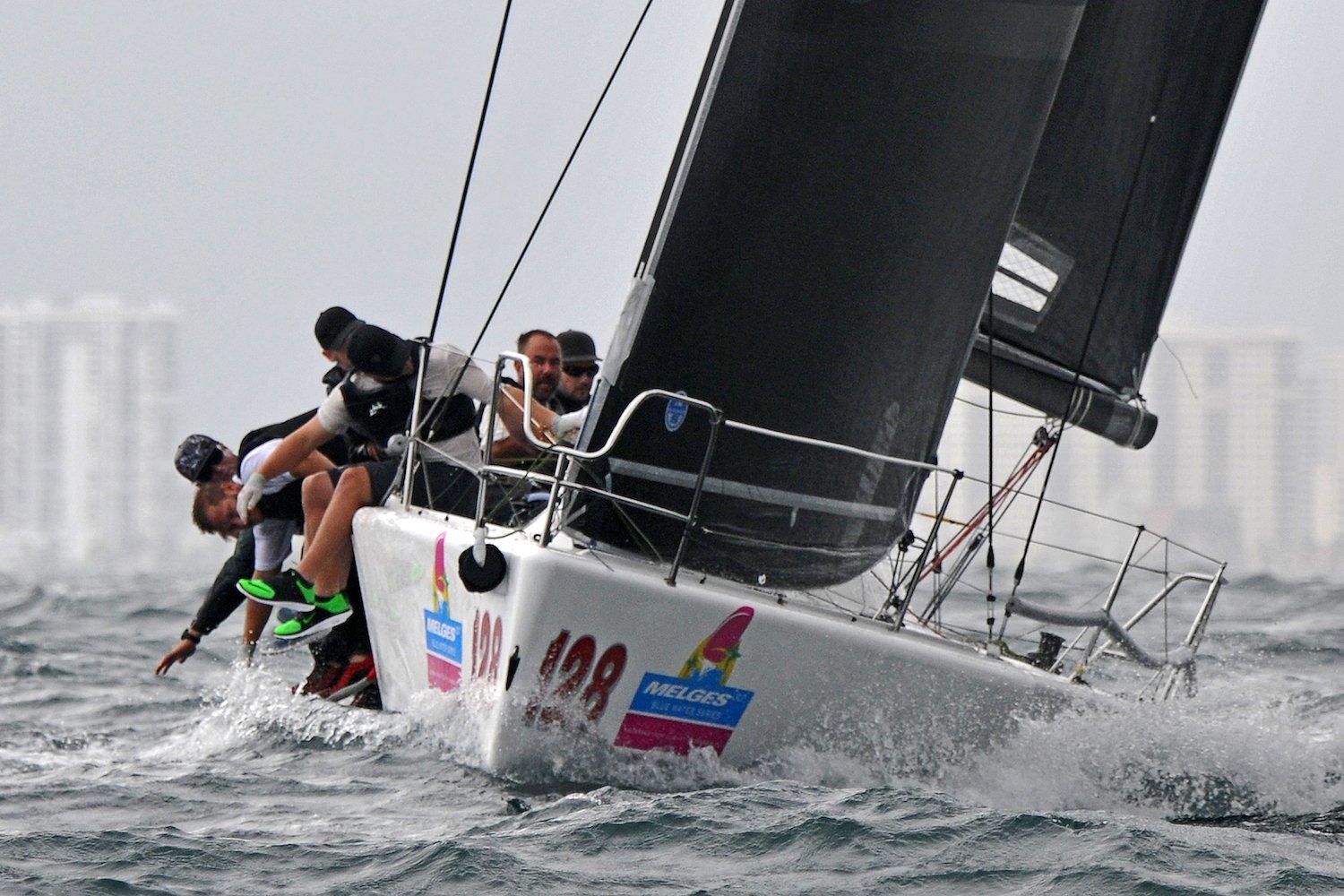
Ft. Lauderdale delivered big breeze and waves for the 11 teams competing at the Melges 32 US Nationals. Jason Carroll’s team on Argo hoisted North Sails 3Di RAW upwind sails and finished in the top three of every race for a convincing overall win. We caught up with Argo tactician, Cam Appleton, about their secret to sailing reliably well and learned it ultimately came down to preparation, teamwork, and sticking to the basics.
Sailors experienced a range of conditions at the Worlds this year, starting with a light 7-9 knt SSE on the first day. Over the three opening races, crews tried to predict the shifts as rain clouds parted. Working farther into the regatta, they sailed into typical Ft. Lauderdale conditions. Saturday and Sunday were dominated by big breeze and equal swells – A mild 14 kt NE built to a high point of 25 knots on Saturday, and maintained at 18-23 knots Sunday with 6-8 foot seas. Argo used their 3Di RAW sails throughout the event, prepping each day for the new conditions. Questions regarding the North Sails Melges 32 sail inventory can be forwarded to the class leaders below. For Argo’s sails specifically: cameron.appleton@northsails.com.
“We try to approach each regatta with the same mindset: to do the basics better than everyone else. When the conditions get harder, the basics become more important. That was the case at this year’s Nationals,” said Cam, who holds a 3-0 US Nationals record on Team Argo.
Start Each Day with 5 focus points… Or four if that’s all you need. On race days these will form your game plan and gentle reminders, and can vary depending on the race venue, the conditions, and who you have onboard. We enter the day with a strategy that plays to our strengths, yet protects our weaknesses until we have the time to work on them. These were our points going into the final day of Nationals:
– On the rig we were looking for a more locked-in zone between bow up & bow down, without excessive heel changes. Gently add a little more jack and go headstay +2 over the North tuning guide.
– After we get setup let’s make sure to do some TOD/Acceleration drills. Get a feel for the boat and how much leeway, how quickly the waves will stop us.
– Timing/rate of turn will change for jibes today. Make sure to recalibrate when we are warming up.
– Very likely asymmetric wave state on the runs. Get a feel for which is the weight back jibe and which is the hiking/more weight forward jibe.
– We’ve said it many times in the past – dominate the boat. Own it! Don’t let it push you around.
Encourage your crew…. everyone onboard is responsible for the boat’s performance. The Melges 32 integrates professional and amateur crew members so everyone is an important part of your success. As sailors we all have an understanding of what goes on and what needs to happen to sail the boat around the race course. As a tactician, being placed in the middle of the crew (on the rail) is key to facilitating communication. There are areas of the race course where different crew members shine and my communication is less instructional. Instead, I communicate a goal and hand over control to the front of the boat. For example, one of our more experienced amateurs is the lead guy for maneuvers. He is responsible for getting his team sorted ahead of time. I find this really helps the communication and directs attention to important factors like where the boat needs to be positioned or speed targets/goals. Trusting and relying on the crew to take care of maneuvers makes the transitions much more streamlined.
Stick to the Basics… Know your mantra and stick to it. Every top coach will drill these tried and true points into you. Most important: HAVE FUN SAILING TOGETHER, regardless of the outcome, because you enjoy each others company. Make that work for the team and you.
– No letters in your score (OCS, DSQ, DNF…)
– Focus on a good start. Be top 1/3 at mark one and pass ONE boat!
– Fight for every place, in every race. Winning a series can very well come down to turning a 12th into a 10th.
– Back yourselves and your decisions: that does not mean you just go on flyers every leg. At times your gut will tell you it’s time to be conservative or it’s a good time for leverage. Think clearly and don’t worry about anyone second guessing where you go on the race course.
– Capitalize on others boats’ mistakes to make passes.
– Stay pro-active with your crew weight and gear changing.
Finally, keep in mind the average winning score is normally 4th, so you don’t have pull a rabbit out of your hat or anything. Finish somewhere in the top 1/3 of the fleet each time and you’ll be in arm’s reach of the win!
READ MORE
READ MORE
TWO AFLOAT: THE JOURNEY TO FATU HIVA
TWO AFLOAT
The journey to Fatu Hiva
“Anyone who has been fully immersed in something difficult and consequential understands the mental shift and clarity such experiences can bring.”
Imagine a room in your home tilted to one side and rocking back and forth with the floor leaning at roughly the same angle as the hand on a clock between 1 and 2. Now imagine the room is also randomly being lifted up about five feet and dropped back down with a bone jarring thud. The room is heated to 87 degrees with nearly 100% humidity. Imagine the room is 30’ long by 12’ wide (with narrower ends) and has a bed, stove, and toilet. The room holds everything you own including your clothes, a few months worth of food, a 50-gallon tank of water, and a 60-gallon tank of diesel. Now imagine spending a week living in that constantly moving room with your spouse, taking turns sleeping every three hours, spending your awake time sitting on the roof in the tropical sun occasionally getting doused by waves of sea-water, all while trying to find a tiny island in the middle of a big ocean.
If you can imagine this then you have some idea what our last week was like, by far the most challenging passage we’ve faced yet.
During the 400-mile open ocean voyage we battled an endless series of violent squalls and shifting winds. It felt like the heavens were determined to beat us back, or at least make us earn any progress forward. Life boiled down to one simple fact- we would safely make it to our destination. Or not.
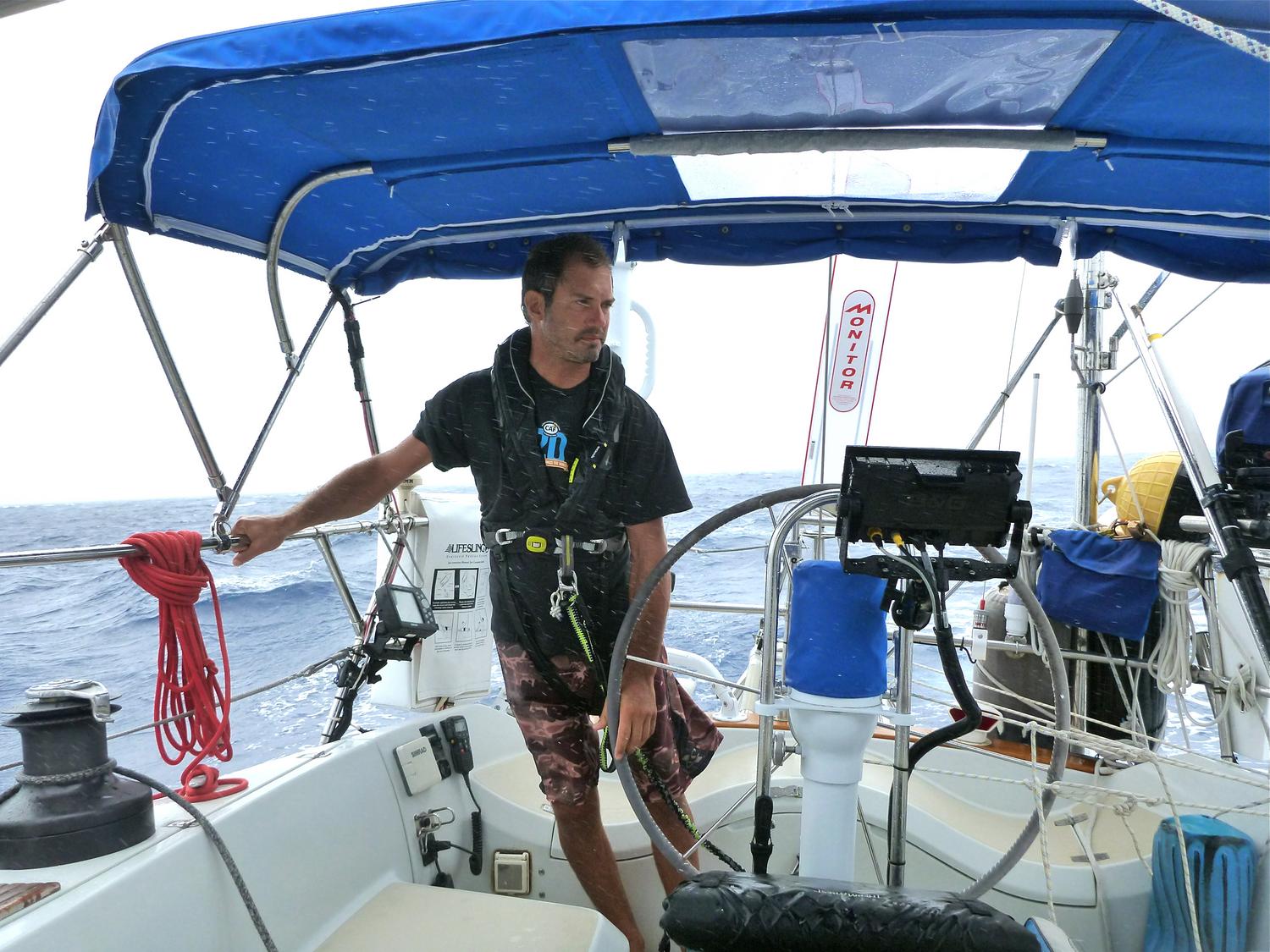
Falling overboard in conditions like that is the ultimate nightmare. One slip and we would find ourselves floating alone in the ocean, hundreds of miles from land, while we watch the boat sail away. To minimize this risk we wear body harnesses and attach webbing tethers to connect us to the boat like dogs leashed to a pole. Moving around on the tilting heaving wet deck involves regularly attaching and detaching the tethers to various connection points and safety ropes.
As the days pass the fatigue deepens. Running and navigating the boat, especially in such dynamic weather, can be difficult enough when we’re well rested. When we’re this tired it becomes an exercise in focus and in automatically executing tasks we’ve practiced many times in preparation for conditions like these. We learn to trust our training and experience while constantly learning from, and adapting to, the changing conditions.
It was a difficult week but it was one of the best weeks of our lives!
Anyone who has been fully immersed in something difficult and consequential understands the mental shift and clarity such experiences can bring. It is something that cannot be explained. Such experiences have a way of stripping away the mental clutter and pretentiousness of daily life, revealing what we’re like at our core. And that’s the scary part- finding out what we’re truly like compared to how we imagine ourselves to be. But if you’ve experienced this than you know what a gift that can be. It’s life unfiltered, wild, and raw.
Despite the discomforts of the passage we had everything we needed- shelter, food, water, and each other. Naoma is our home, she kept us safe, and we love her for that. Eventually we arrived at Fatu Hiva, a small, remote, painfully beautiful island at the southern end of the Marquesas island chain in the South Pacific. We’re now safely resting at anchor while the tropical sun dries our decks after yet another short intense rainfall, a common occurrence in these latitudes. The rain is welcome. It washes away the salt left behind from the passage and leaves Naoma shiny and clean as though nothing had happened. Our sails are neatly flaked and furled, white triangles ready to take us wherever we dare to explore, including the uncharted oceans within ourselves.
READ MORE
READ MORE
F18 ONE DESIGN: THRILL-SEEKERS PARADISE
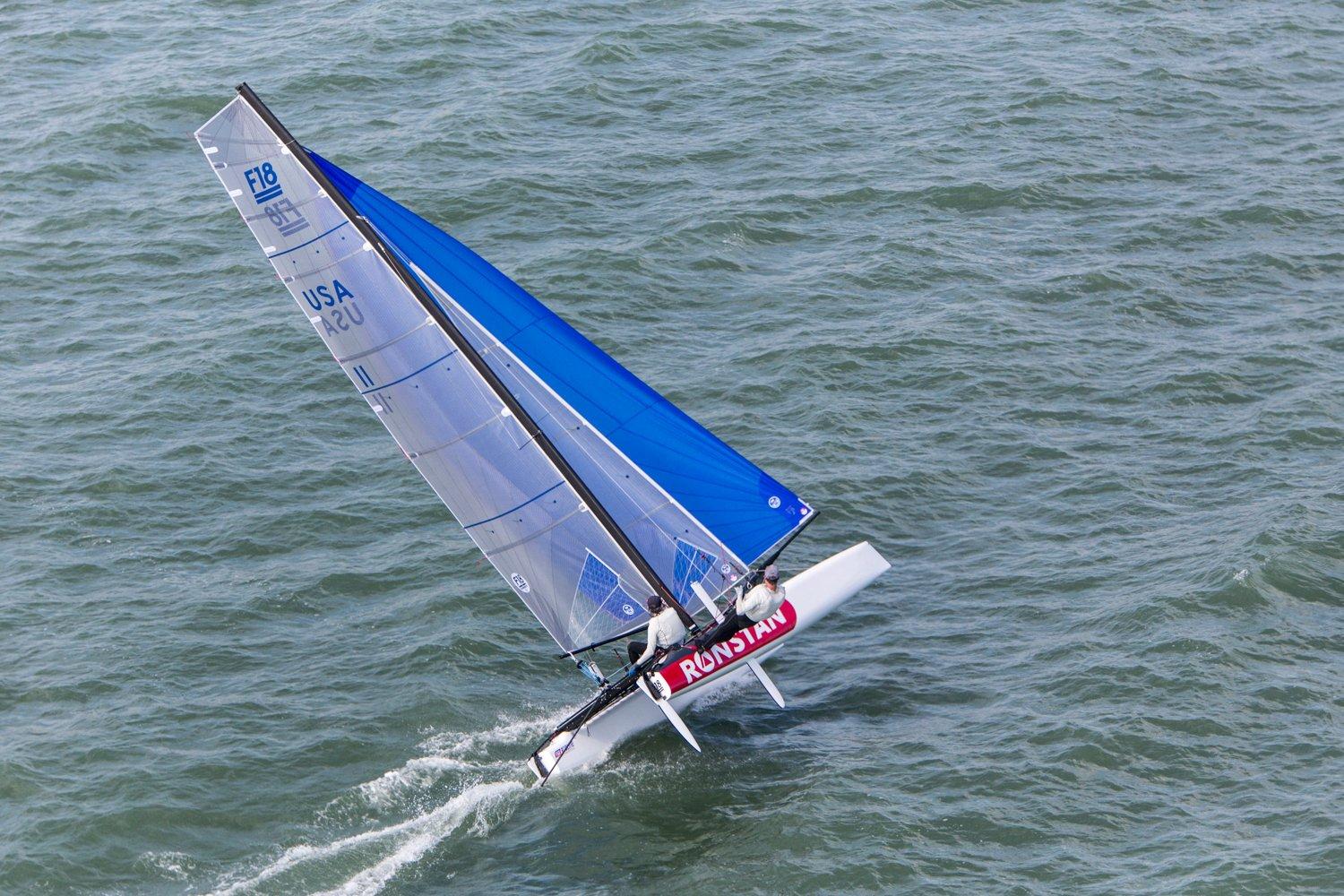
North Sails designer Mike Marshall has teamed up with leaders in the F18 class to develop the North Sails inventory. Since March 2014, Mike has worked closely with Tripp Burd and Olympic hopeful Mike Easton to create a trio of sails that will push their Falcon F18 to peak performance. Using North’s proprietary modeling software to optimize the designs, results were tested with on-the-water trials.
While Mike and Tripp won the 2014 F18 US Nationals with the initial designs, the team found areas for even further optimization. “We’ve since made two generations of the main. The first design adjustment was to allow for better light air performance, and the second was a small shift back in the direction we started with, to preserve the all around performance of the sails,” said Marshall, who has designed for North Sails since 2012 and sailed the F18 for the past year. “The sails give a little more power in light and choppy conditions and are able to flatten out in big breeze despite the extra depth. One final test to go but but so far we are quite happy with the current set as a solid all-purpose option.”
The final test he mentions is the Cata-Cup in St. Barths, where 55 of the class’s top sailors face off in what is traditionally a series of epic big-breeze, big-swell races in the Caribbean Sea. While Mike had a conflict, Tripp took the boat south and enlisted the help of a friend, Bracco Jacopo to drive the boat. The pair finished 19th in the end. During the week Tripp sent in several progress reports:
November 15, 2015 – Tripp
Hey guys, first day of Catacup done. Happy to report that the sails are pretty well sorted. Whatever changes were made to the main bolt rope, luff curve, or batten end spacing has mostly fixed the hoisting problems and our setup seems fast!
One race today, counter-clockwise around the island. Shifty and 5-10 knots for the most part. Rain squall moved through towards the last quarter of the race and launched the lead pack while everyone else got becalmed for a bit. A bunch of teams finished in the dark. The sails have almost the same low end punch as the previous set, which is sweet. During the squall, the breeze cranked for a bit and we didn’t have any major luffing or main inversion problems which was great! We’re sailing heavy this week and light air and chop should’ve killed us. Two races tomorrow, mid-teens supposedly. Should be sweet.
November 22, 2015 – Tripp
It’s been an uncharacteristically light event this year, not the full tradewind conditions we’ve had in the past. Still, we’ve managed to break a few things which has hampered our results a bit. The racing lifestyle is pretty civilized…we’re in for a lunch break right now! The parties and group of sailors here make it a ton of fun. This afternoon will be the last race and we have some Nikki Beach champagne stakes going. Gotta win! I’ll send a good summary tomorrow if that’s cool.
November 25, 2015 – Tripp
A downside to racing in such a unique venue is the long travel home…and it’s a trade I’d make a thousand times. The passionate team of organizers at the St. Barths Cata-cup have consistently delivered the best event in sailing, and this year was no exception. The weather wasn’t as expected. We broke some stuff. Spent hours loading hot 40’ containers, and it’s all worth it. No other event I’ve sailed combines such an exceptional level of competition, with fun racing formats, and an (overly? nahh) full social schedule. Even rounding deep after a botched start, you’re then chasing down a fleet at twenty knots through cliffs, reefs, and ocean swell. Vendee champs, medalists, couples, friends, and families, can all compete on equal terms. My friend, Jacopo, whom I sailed Cata-Cup with, sails once a year…this event. Bringing sailing friends from around the world together, Cata-Cup is a perfect example of why high performance beachcat sailing has such a draw.
For those who aren’t as familiar with the F18 class, it’s a development box rule with restrictions on materials to keep costs down. Turnkey new boats cost under 25k, while 15k gets you an equally competitive ride on the used market. New hull shapes, foil packages, and sail designs keep the tinkerers engaged, while effective weights and rules keep all the designs very close in performance. Performance that can smoke 50’ keel boats and then take a few friends out for a beach cruise. The fleet’s a blast and at the end of the day, we’re all out there sailing to have fun. Events like Cata-Cup keep that spirit blazing.
READ MORE
READ MORE
CHESAPEAKE SERVICE DEPARTMENT RELOCATES
North Sails service and canvas teams join sales team at 317 Chester Avenue in Eastport, Maryland.
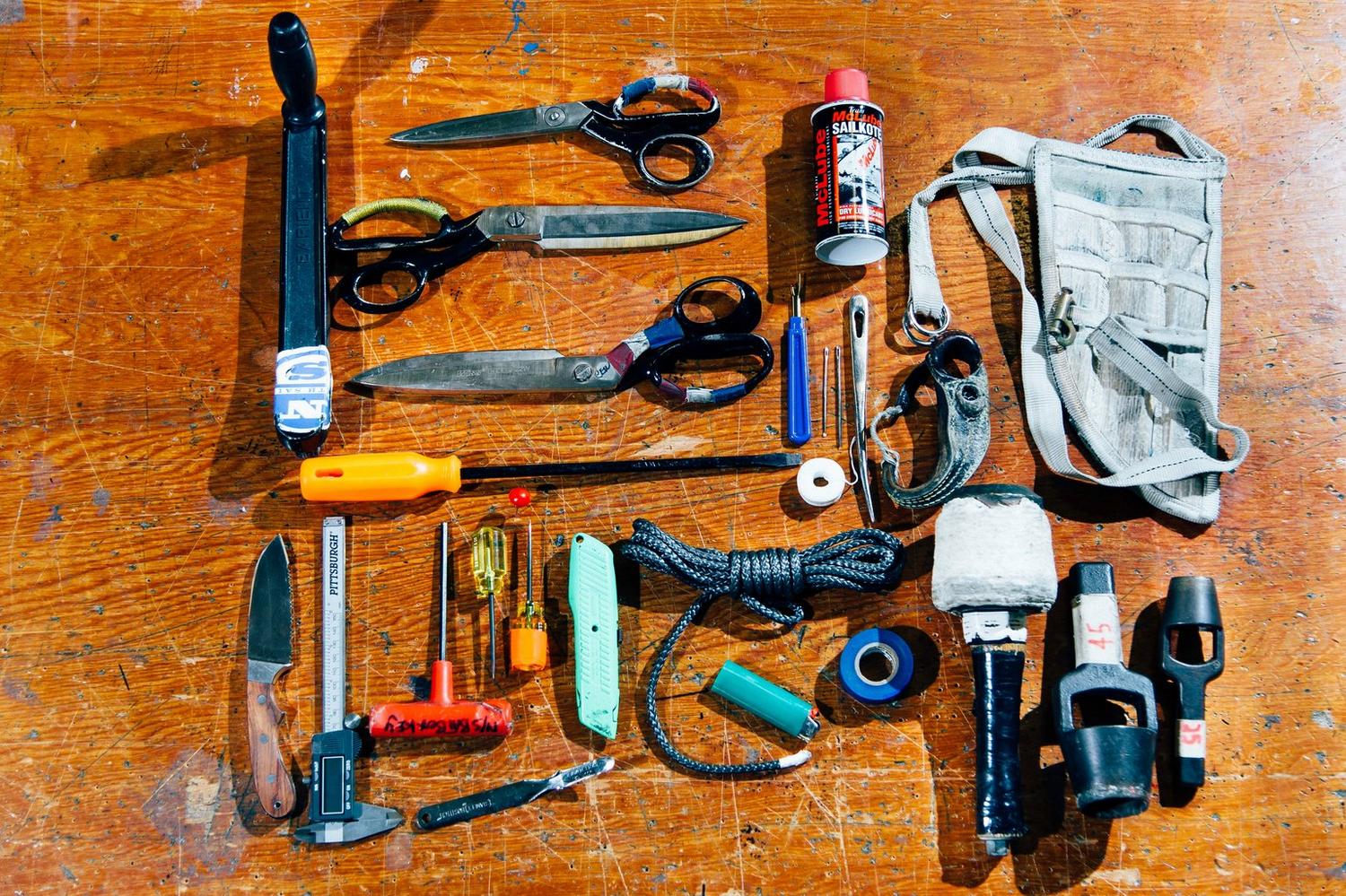
North Sails is pleased to announce that their service and canvas departments on the Chesapeake Bay have relocated from Stevensville, MD to the same Eastport compound as the sales office at 317 Chester Avenue. The newly remodeled sail and canvas lofts encompass two full stories and are equipped to handle sail repairs for boats of all sizes.
“Having everything here in one place makes for a more capable organization, and means that we can serve our clients more efficiently,” said Jonathan Bartlett
Service Manager Jeff Todd and his team of experienced sailmakers pride themselves with quality workmanship that is completed in a timely and efficient manner. “Now is the ideal time to bring your sails in for year-end inspection so our team can identify areas of wear and tear before they become a bigger issue,” said Todd, who has been a sailmaker for more than three decades and is also a well-respected Chesapeake Bay area sailor. “A simple sail check can help protect your sail investment and help you get the most out of your on-the-water experience,” Todd said. The Chesapeake service department is open Monday-Friday from 8:00am to 5:00pm or by appointment.
North Sails Canvas, managed by Rob Pennington, occupies the first floor of the building. With room to lay out products ranging in size from small one design covers to full winter covers for cruising boats, they are in an ideal spot to meet customer needs. “We are really happy to be back in Annapolis for the convenience of our customers and better proximity to yacht clubs and marinas,” Pennington said. “This relocation is a win-win for everyone.”
Jonathan Bartlett, Sales Manager for the Annapolis office is very eager for the group to get settled in. “Having everything here in one place makes for a more capable organization, and means that we can serve our clients more efficiently,” Bartlett said. “We have worked closely with our service and canvas team for many years. Having them in the building next door makes the customer experience seamless, which is very important to us,” Bartlett said.
For additional information on North Sails’ Annapolis loft location, please contact Jonathan Bartlett at: jonathan.bartlett@northsails.com or call 410.269.5662.
READ MORE
READ MORE
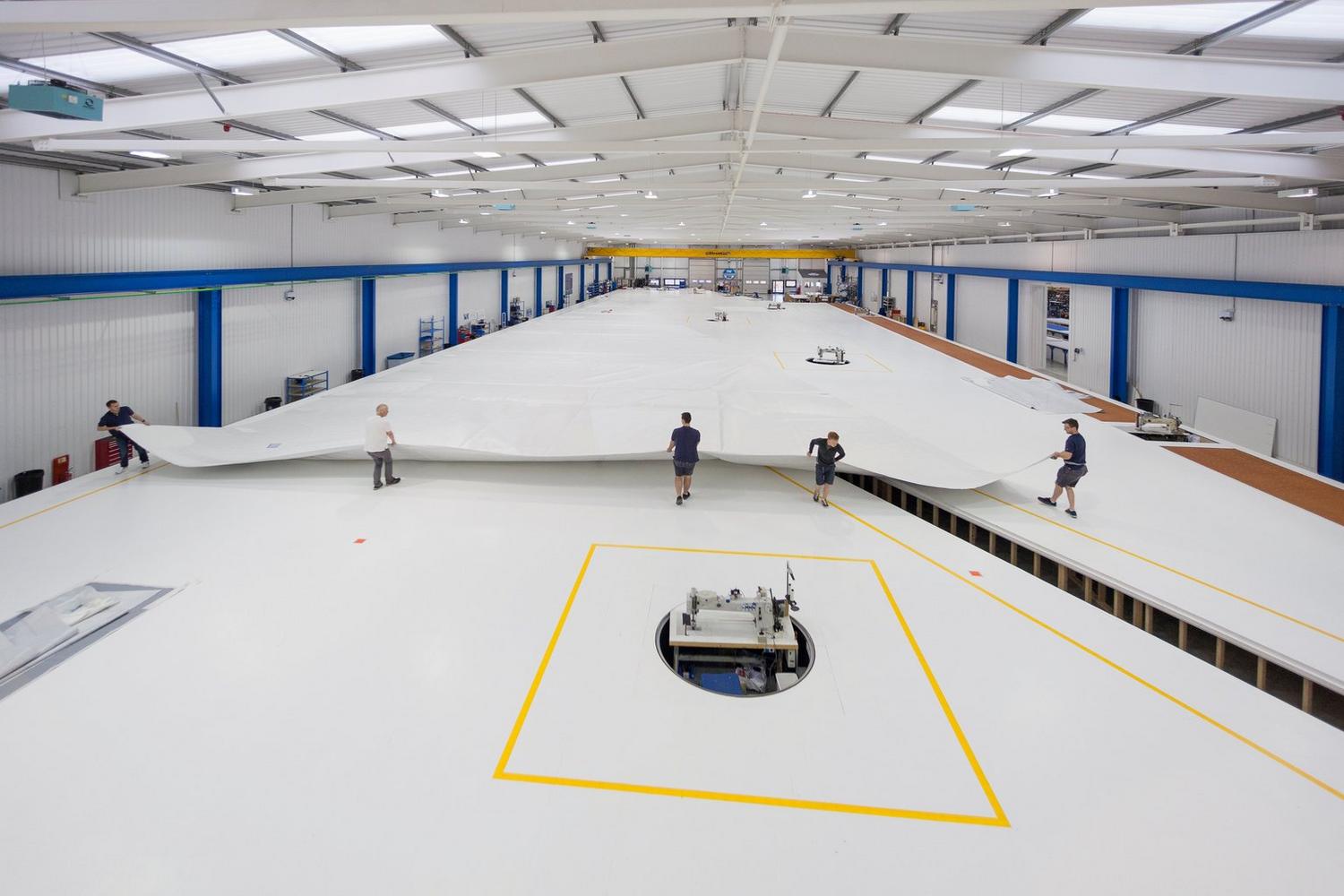
MEET THE CREW AT NORTH SAILS GOSPORT
As North Sails prepares to open a new one-of-a-kind manufacturing loft in Gosport, UK, we go behind the scenes with the people who make the best sails in the world.
This week North Sails will officially open their new UK sail loft based in the maritime south coast hub of Gosport. The loft will incorporate many global departments under one roof: North Sails 3Di and Superyacht finishing, One Design sail production and Certified Service. It is the first loft of it’s kind to specialize in superyacht sails and boasts the largest raised finishing floor in the world at 1,950 square meters. Once again pushing the boundaries of sail technology, innovation, and manufacturing, this will be the North Sails flagship facility in Europe. Here’s what some of our team members have to say:
Rich Bell, Sail Design and Production Coordinator at North Sails Gosport
I have been with North now for coming on 19 years in various roles. I started I the loft floor thinking it would be a short term job to learn a little about my hobby of sailing, and soon enough I found a career in sailmaking! I describe my job as being the link between our sail designers and our team on the One Design loft floor. Working within the design group, my background in production helps me think of all the details our sailmakers will need to keep our operations running efficiently.
While I love to sail I’ve never been a top sailor, just a competent club sailor. Through North Sails I have hugely improved my own sailing and had the chance to work with many Olympic medalists and World champions, and hopefully I have contributed something to their campaigns through my work.
A typical day usually starts by catching up on operations in Sri Lanka and answering any questions they have. Noting the time difference, I like to sort any issues for them first so they don’t have to wait a day. The rest of the day fills quickly with tasks such as writing work tickets or resizing sail designs for class rules. Often I will take time with OD sailors & coaches to understand their needs, and then work with the team on the floor (pictured) to develop a new finishing idea.
Our new facility is already showing benefits simply by having all of our departments in one space. We are able to share ideas easily and understand how our teams work. Just listening to the daily conversations of the superyacht sail designers can be an education in the level of expertise North has in different areas of the sailing world.
Adrienne Fekets, Pre-Fabrication at North Sails Gosport
I have been working with North Sails since 2005. I love everything that is related to sailing and sailmaking. Although sailmaking can be a physical job I relish the challenge. Over the years I have been involved in all areas of sailmaking, from cutting and sticking panels, joining, second laying and finishing.
Today I work in pre-fabrication at the new loft, where I prepare and assemble parts, fittings and accessories to design specification. I am responsible for the details. Organizing and executing the information we have, our team provides all necessary components for the sails on the floor and those coming up.
Investment in the loft and the development of our processes has a positive effect on our total staff from top to bottom. Our new space encourages quality and attention to detail which are paramount at North Sails.
Clym Arnold, paneled sail plotter at North Sails Gosport
I first started at North Sails about 10 years ago. Between now and then I worked as a sail cloth production planner and purchaser at an external company, and was happy to bring that experience back. I really enjoy the atmosphere here, they’re a good bunch to be with and I’m proud of our end product, especially the superyacht sails. It’s nice to be a small part of something so inspiring.
My process is very methodical. I fire up the laser plotter and then go through daily checks. If there is a new sail to start I load up the CMD file onto the plotter, set the designated cloth and start cutting the sail panels. Some cloth cuts easier and quicker than others but usually I can clear the table as the plotter is cutting (pictured). As the panels come free I sort them into relevant sections to make the next job in the production line easier. My set up in the new building provides necessary space to sort materials immediately, where as before this would be done as a separate step entirely and take up a lot of time. The only real set back is the hike over to the next production location. I’ve suggested we all need Segways but I don’t think the budget will stretch to that!
Ever thought of joining the North Team? North Sail is hiring sailmakers for our One Design and Yacht Sails teams at the new loft in Gosport, Hampshire, UK. All the details here: http://goo.gl/0Q3ZFI
READ MORE
READ MORE

IT'S NOT JUST THE SAILS
Tony Mack of J-111 McFly credits North Sails ‘total customer support’ in over 20 years of sailing success
Tony Mack and crew on North Sails-powered J-111 McFly are looking back on an impressive 2015 season; winning their class in the BVI Spring Regatta, the Vice Admirals Cup, the J-111 Class at Cowes Week and the J-111 UK National Championship. Tony is a valued North Sails client of over 20 years, well known by the staff at North Sails in the UK who have supported his endeavours in the IMX-38, Swan 45, Beneteau 47.7, and most recently the J-111.
North Sails’s Jeremy Smart called tactics on McFly for the 2015 Season, having supplied a new suit of sails for the boat last year. The new inventory included the latest North Sails 3Di™ 870 RAW for the mainsail and J-1, and 3Di 780 Standard for the J-2 and heavy weather jib. “McFly was one of the first boats in the class to adopt 3Di RAW. Overall the crew was really happy with the feel and adjustability of the sails, though equally important to Tony is the service and support from our staff over the years.” While Jeremy is working with McFly on the J-111, other members of the North Sails team have been equally involved in previous seasons, including – sales manager Bob Lankester, Neil Mackley, and long-time North Sails designer, Dave Lenz. Tony Mack credits quality customer service as the reason he returns to North Sails as the sailmaker of choice,
“I have dealt with North Sails for over 20 years and feel they lead the way in sail design and development. However, the service has never stopped with just the sails. They employ loads of REALLY good sailors who are available to help their clients in choice, trim and boat handling. They have assisted with coaching owners and crews who would like to win more races, as well as cruising sailors who would like to improve their sail trim and get to their destination a little sooner. It is a classic example of total customer support – long may it continue.” For more information on North Sails J-111 products please contact Jeremy Smart (jeremy.smart@northsails.com) or visit csd.northsails.com.
READ MORE
READ MORE
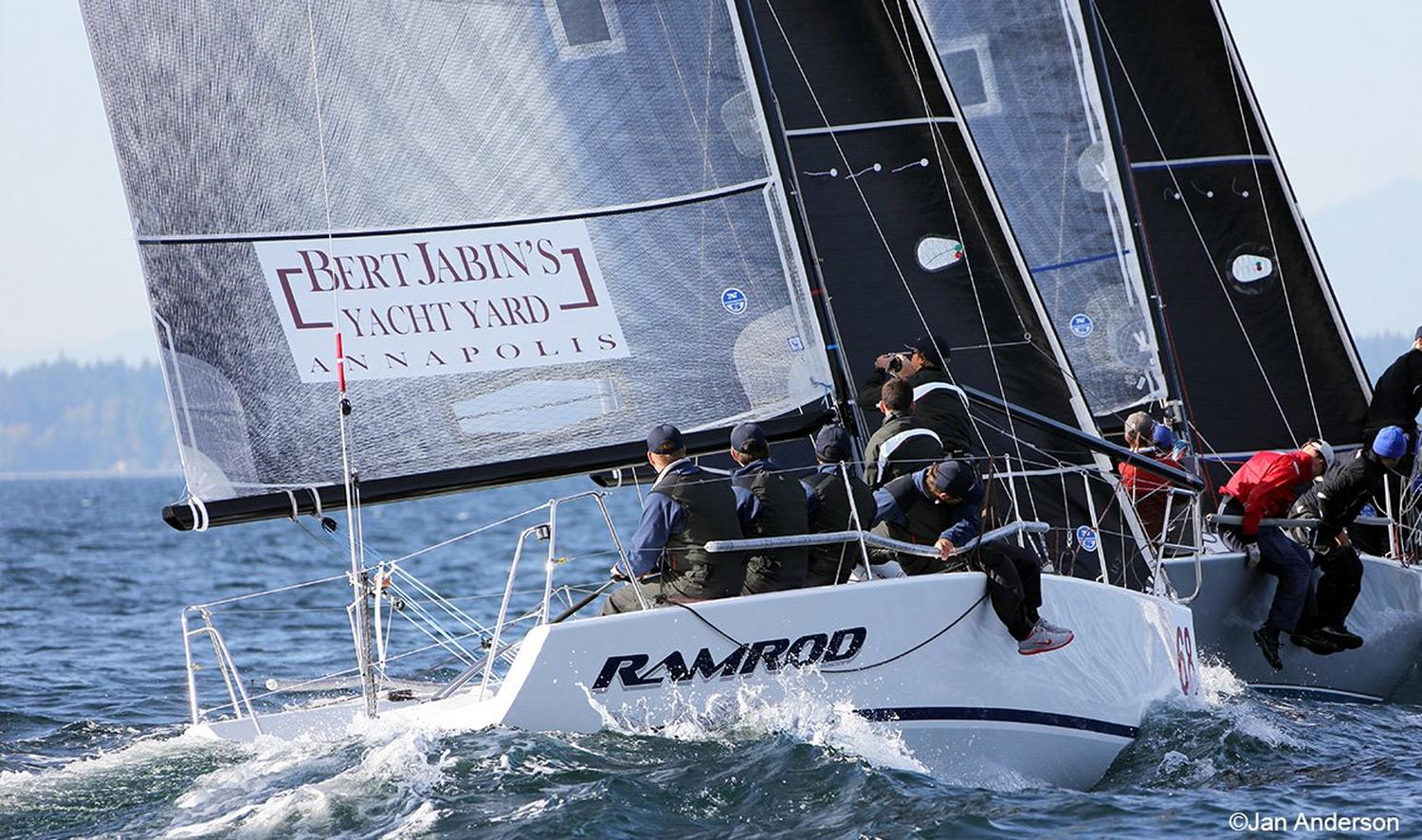
TEAM RAMROD WINS FARR 30 WORLDS
Congratulations to Rod Jabin and team Ramrod for winning the 2015 Farr 30 Worlds in Seattle, Washington. Racing with a brand-new set of North sails, Jabin attributed much of his success to his new sail inventory and a core group of sailors, including tactician Chris Larson and mainsail trimmer Darren Jones, who have sailed with Jabin for many years. “Our boat preparation, new sails, and teamwork gave us the edge for sure,” Jabin said. Congratulations to 2nd place Seabiscuit, 3rd place Through, and 4th place Patricia* who also sailed with North Sails inventories.
Jabin, who bought his Farr 30 in 2013, last raced in a World Championship the same year in Newport, RI, where Ramrod finished third overall. “We’ve been working hard for the last two years checking off the boxes to make sure the boat is in the best shape it can be.” said Jabin, owner of Bert Jabin Yacht Yard in Annapolis, MD. “We paid special attention to planning out the right sail buttons to have the ideal sail inventory going into the World’s. The entire crew was fantastic but Darren and Chris are the ultimate crew members who consistently got us off the line and always made the boat go fast,” Jabin said.
Team Ramrod trained for the World’s in August at Chester Race Week in Nova Scotia, where there is a strong Farr 30 fleet. “We wanted to look at our new sails – 3DL™ mainsail, 3Di™ RAW jibs, and two new spinnakers – at Chester Race Week to see how they felt and performed. They were so good, one of the other Farr 30 owners ordered one of the same 3Di RAW jibs before the regatta was over! It didn’t take long for Darren to tune the rig and mainsail to his liking using North Sails’ Farr 30 CSD Tuning Guide. Immediately we knew the sail designs were fast, which gave us a lot of confidence heading to Seattle,” Jabin continued. “I couldn’t have been happier with the entire sail inventory we received from North Sails.”
“North Sails’ Farr 30 Class Sail Development (CSD) sails once again proved their strength with customers using both the 3Di and 3DL product lines with a lot of success,” said North Sails representative Chris Larson. “Rod is great to sail with. He never leaves a stone unturned when preparing for events, which makes it a pleasure to be part of the Ramrod program. I look forward to sailing with this team again to defend our title,” Larson concluded.
It’s too soon to say what will be on the schedule for team Ramrod next year. During the winter months, Jabin will give the boat a rest and will take good care of his new sail inventory. “We always take our sails off the boat during the winter and factory fold the kites. We lay out our upwind sails and give them a fresh water rinse to get rid of any salt water,” Jabin continued. “After they’re fully dry, we roll them and put them back in their sail bags and store them in a climate-controlled space to keep them dry. This routine has always proved to keep sails long-lasting. When we get them out in the spring, they’re ready to go and look great,” Jabin concluded.
North Sails congratulates all our customers who raced at the Farr 30 Worlds. For more information on Farr 30 CSD sails, visit the North Sails website.
READ MORE
READ MORE
TWO AFLOAT: MOOREA ADVENTURES PART 2 - WATER
“If you surrender to adventure there are no failures along the way, just unexpected steps in a journey that is only revealed as the story unfolds.”
Nicole and I were happily snorkeling in clear blue water, surrounded by giant stingrays and blacktip sharks, when suddenly the sharks began to frenzy. They began swimming rapidly in tight circles, twitching and slashing, clearly excited about something at the surface. I looked above the water and saw two somewhat drunk men in a small boat laughing while throwing bloody fish scraps in the water next to us. .
Our friend’s fearless 9-year old daughter Fran was with us. Her eyes were wide with excitement and glee, I’m sure she would have swam into the middle of the school of thrashing sharks if Nicole and I ha
dn’t decided it was time to move on. We placed Fran between us and swam back to the dinghy. “That was SO COOL!” Fran exclaimed as we motored back to the anchorage. Nicole and I looked at each other and nodded in agreement, it WAS cool.
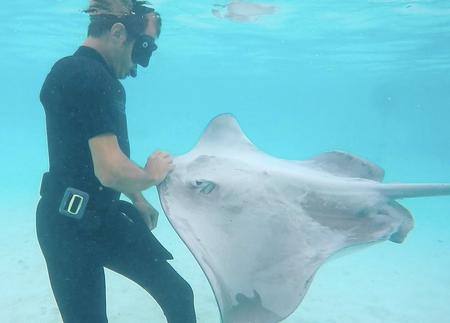
Before the sharks got crazy the giant stingrays had all our attention. They were incredibly intelligent, sometimes swimming to specific people they recognize and positioning themselves in specific ways to solicit a nose rub or to offer a short ride. The rest of the time the rays would swarm around us, rubbing against us looking for food and attention. It was like having a 360-degree stingray massage. Before the frenzy the sharks continuously circled in the distance hoping for whatever scraps of food the rays might leave.
This all took place in the middle of the huge blue and green lagoon about a half-mile from shore. The rays were wild, free to leave at any time, but they would repeatedly return to play long after the food was gone.
When we arrived back at the anchorage we dropped a still beaming Fran at her parent’s boat and decided it was time to clean the algae off of Naoma’s hull. We scrubbed the bottom while spotted eagle rays and all kinds of tropical fish swam around us in the warm clear water.
Cruising offers the unique opportunity to experience the ocean as something much deeper than just an aquatic highway for boats to glide over. There is a tangible energy in the weightless depths beneath the ocean’s surface, an alien world of stunning colors and shapes, full of more life per unit of area than the dry world we know at the surface. The oceans are the source- they drive our weather, provide much of the oxygen we breathe, the food we eat, ultimately even the water we drink. The ocean’s waters are the last surviving wilderness, with infinite undiscovered wonders hidden in her depths. It’s a gift to drift weightlessly in her embrace.
After we finished cleaning the hull Nicole noticed something large floating on the surface about 100 meters away. From our vantage point it almost looked like a large log but suddenly a spout of water blew up with a loud whoosh. A humpback whale! We quickly hopped in our dinghy and moved to a position ahead of where we hoped the whale was swimming. We shut off the motor, slipped into the water, and waited silently.
Soon an enormous shape gracefully materialized out of the blue. It was the whale, leisurely drifting on the surface directly towards us. Nicole let out an excited squeal when the whale got closer and we realized it was mother with her calf!
The baby whale was almost as large as our sailboat and was drifting along close to its much larger mother. Occasionally the calf would gently lean into its mother as if giving her an affectionate nuzzle.
The mother drifted along motionless and peaceful but always keeping a watchful eye on us. After a while she gently swooped her pectoral fins, lifted her tail, and together with her somewhat less graceful calf, disappeared into the depths.
All these experiences began with a dream, a boat, and some white triangles to drive her. Now we’re dancing with stingrays, watching sharks feed, and drifting with whales, all afloat together, in this adventurous humbling inspiring life at sea.
READ MORE
READ MORE
NORTH SAILS EXPANDS ON GREAT LAKES
Al Declercq and Team Join North Sails
North Sails is pleased to announce that accomplished sailor and experienced sailmaker Al Declercq and his team have joined North Sails. Declercq, based in Detroit, MI, is returning to North Sails after a 22-year hiatus and made the decision with their customers’ best interests in mind. “North Sails leads the sailmaking industry with superior products and excellent customer service and sail care. It was the right choice for our client base and we are thrilled to be back with the North Sails team,” Declercq said.
“North Sails is committed to improving our presence and providing more sales representatives and sail care lofts to the thousands of sailors on the Great Lakes,” said Ken Read, President of North Sails Group. “Earlier this year, we partnered with Skip Dieball and we are thrilled that Al and his team have decided to join North Sails as well,” Read continued. “Between Al and Skip in Detroit, and our existing sales and service centers in Chicago and Toronto, they will anchor a network of North Sails lofts from Thunder Bay to Montreal. Personally, I am excited about the strength of the team we have to support the beautiful Great Lakes region,” Read concluded.
Throughout his career, Declercq has raced in the Fastnet, Transpac, Newport to Bermuda (five times) and several other notable offshore events.
He has raced in an unprecedented 49 Port Huron to Mackinac races and 36 Chicago to Mackinac races, winning a total of 26 times. “I know sailors who have worked with Al for more than 20 years because of the excellent customer service and sincerity he and his team are known for,” said Kimo Worthington, Sales Manager for North Sails in North America. “Al has sailed over 50,000 miles on the Great Lakes which makes him an undisputed expert for sail needs in that region,” Worthington said. “We welcome Al and his team, including wife Sara, who will be the Detroit office manager.”
“Returning to North Sails is a win-win for our clients and our team,” Declercq said. “North Sails is the worldwide leader in sailmaking because of technology and innovation that results in the best products and value on the market,” he continued. “We are proud to offer our clients such a vast range of products, from paneled sails to 3D sails. We have a number of cruising clients who will be amazed by the North Sails difference and we intend to work hard to keep them all happy and satisfied with their sail investments,” Declercq concluded.
Al can be reached by calling 586-790-7500 or by email:
READ MORE
READ MORE
3Di RAW SAILS WIN ROLEX FARR 40 WORLDS
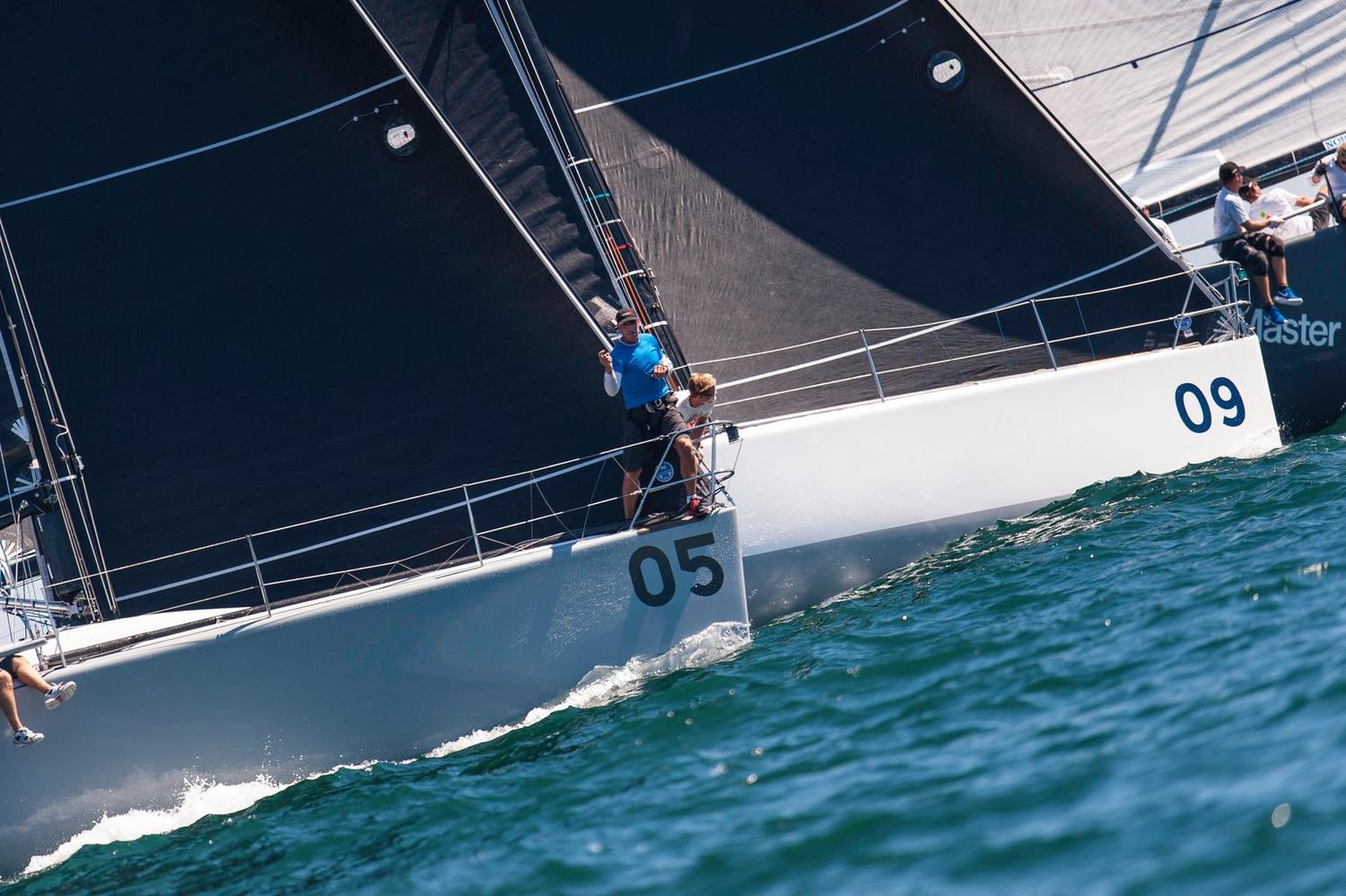
It’s the North Sails way to let our products prove themselves on the racecourse, and the new Farr 40 3Di® RAW sails have powered John Demourkas and his Groovederci crew to the 2015 Rolex Farr 40 World Championship title. Demourkas bested a competitive fleet to pull off what he considered an unexpected win.
“We did surprise ourselves,” said Demourkas. “We put all our effort into winning and the team’s never-give-up mentality made first place at the World’s possible. It’s now a few days post-event, and this is all still sinking in. An unexpected victory is that much sweeter.”
Demourkas and his team worked with North Sails as one of the testing programs for the 3Di RAW development through the 2015 season. “The decision to introduce 3Di RAW sails into the Farr 40 class came after we were disappointed by our sail inventory performance during the 2014 Farr 40 season,” explained Paul Westlake, Global Head of Sales. “Developing RAW was a risk as our design and engineering teams were developing something completely new rather than tweaking the benchmark 3DL® product,” Westlake continued. “It a classic case of taking a high risk for a high reward. Groovederci’s win is an example of North research and innovation at its best.”
Sail development and design was led by Burns Fallow, Giovanni Cassinari, and Per Andersson. North Sails Farr 40 Class experts Chris Larson, Marchino Capintani, Grant Spanhake and Dave Scott worked directly with Groovederci and Enfant Terrible as the on-the-water trial horses. The tireless dedication to providing on and off the water feedback to the design team and support for all North Sails customers proved to be one of the edges, once the competition heated up.
“I strongly believe in the North Sails technology. We knew working with the North team on the evolution of 3Di RAW would result in a superior product,” explained Demourkas. “We went through three mainsails before arriving at the latest generation that helped us win the World’s. Our final set of sails North delivered before the event were on spec and impressive. The sail shapes are flatter giving us power with the least amount of drag, and the removal of the 3Di outer skins saved significant weight,” Demourkas continued. “We spent the final days leading up to the World’s working with Per Andersson on little tweaks to fine-tune our performance. North Sails has supported the Groovederci program for the past 15 years, and I am proud to be a part and support their development of 3Di RAW.”
“The mainsail development for Grooverderci started in January during the North Sails Pro Summit in Minden, Nevada. Four of the crew attended the summit and met with Burns Fallow and his design team. After listening to the crew’s request it was clear that there had been a big change in the way sails were trimmed since the 2014 season, a similar trend recently seen in the TP52 class. The first 3Di RAW Farr 40 test mainsails had luff curve alterations. Feedback from the team was incorporated into the second set of sails and from there it was minor tweaks to final inventory that went onto win the Worlds.”
“The mainsail we developed is on the flatter side and really seemed to hit its stride over eleven knots,” said Fallow. “Other features on the main were a shift in both the vertical and horizontal distribution of curvature.”
“Our job is not done, it’s just begun” added Westlake. “Three days after the final World Championships we are well into debriefing the flying shapes and performance ranges of each sail to set a baseline for the 2016 inventory. The performance advantages of 3Di RAW structure, coupled with the successful flying shape and tuning matrix evolution from this seasons Farr 40 circuit and Worlds success provides the base required to finalize flying shapes in time for the 2016 Worlds in Sydney Australia.”
Sydney is a unique venue where playing the waves has a significant impact on race strategy. The weight savings and stability of RAW in waves will prove successful in helping teams power through the local conditions. North Sails Farr 40 inventory tweaks will be released next week in time for teams to optimize their 2015/2016 sail button allocation.
Contact North Sails Farr 40 class leaders Chris Larson and Richie Allanson for more information on Farr 40 sails.
Class Leader Contacts:
Chris Larson
chris.larson@northsails.com
+1 443 994 4000
Richie Allanson
richie.allanson@northsails.com
+61 2 9998 8500
READ MORE
READ MORE

IRC DOUBLE-HANDED RACING IN THE SOLENT
Hot Cookie Wins Class One of the 2015 IRC Double Handed National Championship
37 boats took part in the IRC Double Handed National Championship for 2015. The event was held in the Solent on the south coast of the UK and organised by the Royal Southampton YC and the Royal Ocean Racing Club. It is the second time this championship has been run and the racing was held for three IRC classes.
Light winds on the Saturday meant the passage race could not take place but two races were completed when the wind filled in during the late afternoon.
In IRC One the Sunfast 3600 Hot Cookie won both races taking the win in this class. The boat was raced by Neil Martin and Phil Barnes who have been racing together for about ten years. After trying a few different types of boats for two handed events over the years they moved to the Sunfast 3600, which is well set up for two handed sailing.
Hot Cookie is powered by an inventory of North Sails optimised for two handed racing.
READ MORE
READ MORE
BODACIOUS DREAM: OFFSHORE SAILING WITH 3Di
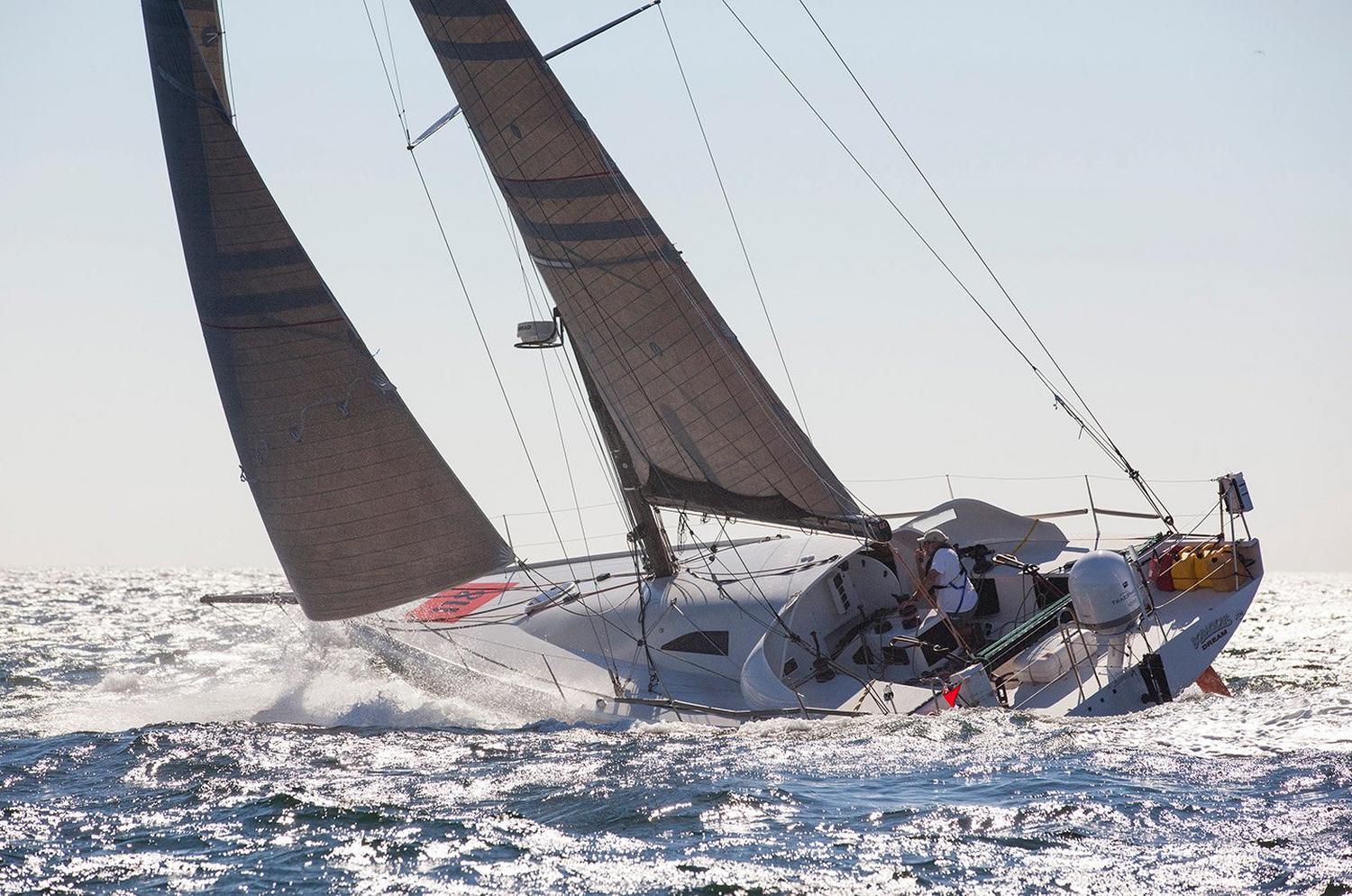
A solo sailor at heart, Dave Rearick had a lifelong dream of sailing around the world. After years of racing both internationally and on his home waters of Lake Michigan, Rearick crossed paths with Jeff Urbina and Gaye Hill. Together, the trio envisioned an around-the-world expedition with an environmental focus. Through the creation of Bodacious Dream, Rearick would sail single-handedly around the world and bring the experience full-circle to followers via the campaign’s website and social media accounts. “One our biggest goals for Bodacious Dream Expeditions was to give people an opportunity to learn about the ocean, and foster awareness that it needs our help” said Rearick. A Kiwi 40FC (Class 40) designed by Bruce Farr and built in Wellington, NZ, the Bodacious Dream was ready for racing in early 2012, outfit with a fresh inventory of North sails.
First up on the training schedule was the 2012 Atlantic Cup, an offshore race committed to being the most environmentally friendly in the United States. Rearick was introduced to Richard “Bicky” Bicknell, of North Sails in Auckland, New Zealand. After weighing many options, it was decided that Bodacious Dream would be among the first of its kind to sail with North Sails 3Di. “North Sails delivered a beautiful 3Di 760 main and solent jib for us, designed with the keen eye of Auckland-based sail designer Magnus Doole,” said Rearick, who hoisted the new sails for the Atlantic Cup start in Charleston, SC that May. With a 3rd place finish in Leg 1, Rearick and double-handed partner, Matt Scharl, went on to win the 2nd leg from New York City to Newport, RI and, after racing the inshore portion with a six man crew (including North Sails’ Jay Hansen), claimed 2nd overall. Bodacious Dream was off to a great start. “In the following year, we competed in the Quebec to St. Malo race, the Normandy Channel Race and the Class 40 Worlds in France,” said Rearick, who sailed solo back to Rhode Island after the worlds. Racing again with Matt Scharl, Bodacious Dream won the 2013 Atlantic Cup and before he knew it, Rearick was gearing up for his October 2nd departure in the Global Oceans Race to sail singlehandedly around the world.
“Most sailors underestimate the amount of preparation it takes to complete a circumnavigation,” said Rearick. “The entire boat is constantly maintained. Before long legs, we always had the sails looked over by the local service crew. The Durst brothers at North Sails in South Carolina took good care of us during our Atlantic Cups, and before the first leg to Bermuda, Eric Wakefield and his team at North Sails in Rhode Island did another check-over and installed a top reef in the mainsail. I cannot say enough about their reliable and friendly support.”
“The Bodacious Dream was about becoming more aware of our presence on earth, and I feel that was a success. By spending time on the ocean, we build a philosophy of awareness.”
In a perfect world, Bodacious Dream would have sail a lap around the planet alongside other single and double-handed sailors from around the world. Rearick made the tough decision to set off alone after news broke that the start of the Global Oceans Race 2013 would be postponed to the following year, “Dreams never come true the way you plan them. You have to take what you can get and make the most of it” said Rearick.
Bodacious Dream set off from Jamestown, RI that October and made it to Bermuda without a hitch. She soon set sail for Cape Town – first heading south through calm vistas and light storms to the bulge of Brazil, then east to arrive in Africa on December 2, 2013. From Cape Town, Rearick took on the Southern Ocean en route to Wellington, NZ. Upon arrival, Bodacious Dream had sailed just over 30,000 nautical miles – all with the same main and jib that Rearick hoisted for the 2012 Atlantic Cup. North’s Bicknell met Rearick in Wellington for a sail check. “Bicky was pleased with how the sail shape was holding up, and after some quick maintenance at the loft in Wellington, I was headed for the Galapagos.”
Bodacious Dream was one of the first Class 40s to adopt 3Di, which at the time was fairly new to offshore sailing. Designer Magnus Doole tailored an inventory of versatile sails capable of accepting the wide range of wind speeds and sailing angles typically found in offshore sailing. “The main and jib on Bodacious Dream are some of the earlier 3Di offshore sails that we’ve made. Doug Slocum and I made adjustments to our standard 3Di layouts to bring them more in line with what we saw in the VOR70 class. Our goal was to reduce the overall weight without compromising their durability and shape holding capacity. After checking in with the boat in Wellington, we were happy to find evidence of longevity in both material and shape,” said Doole, who specializes in designing offshore sails for Class 40s, TP52s, the Volvo Ocean Race, and various maxi yachts.
As of today, the North Sails 3Di 760 main and jib on Bodacious Dream have sailed just under 43,000 nautical miles. Rearick will continue to take good care of them, “I’ll say again that maintenance is critical. As a whole, the North Sails sail care network has done a great job and I had no major setbacks during the trip. The sails are still in great shape, and I would not recommend anything other than 3Di for offshore sailing or long term cruising” said Rearick.
Rearick and Bodacious Dream were welcomed home by friends and family in Rhode Island on June 12, 2014, having completed a lap around the world in eight and a half months (including downtime).
“The unexpected parts were the most memorable,” said Rearick, recalling a moment aboard after a thunderstorm in the southern ocean. “There was one night on the passage from Cape Town to Wellington; the clouds cleared after the storm and everything was pitch black. All around me there were masses of bioluminescence in the water. What appeared to be these immersed glowing orbs were lighting up the waves around the boat. It was magical not knowing what they were, feeling like I was afloat in a star-lit space for a mile.”
“The Bodacious Dream was about becoming more aware of our presence on earth, and I feel that was a success. By spending time on the ocean, we build a philosophy of awareness. Paying attention to our environment is a critical part of life on earth, and it starts with awareness.”
READ MORE
READ MORE
WHAT IT TAKES TO WIN THE J24 WORLDS
At times the costs and disappointments nearly sunk us, but we kept going through to the 2008 Worlds, where we were third yet again.
READ MORE
READ MORE
TWO AFLOAT: MOOREA ADVENTURES PART 1 - AIR
If you surrender to adventure there are no failures along the way, just unexpected steps in a journey that is only revealed as the story unfolds.
We sailed away from the Tuamotus this morning with weather looking favorable for a passage to Tahiti but here we are bashing across the sea, close-hauled, our sails deeply reefed and trimmed flat, as we cruise through a series of tropical squalls. We can still make Tahiti on this tack but the constant heel and violent pounding convinces us to bear away towards Moorea instead. We will not reach our intended destination but I think life is good when the big decision is between sailing to Tahiti or Moorea.
We approach Moorea with no information beyond what we see on the charts and some vague tips from a friend. But we’ve learned adventure rewards those who trust fate, a fact confirmed by the breaching Humpback whales that greet us while we sail through the reef pass into a deep blue bay surrounded by towering green mountains.
We set the anchor in a protected corner amongst a small flotilla of other cruisers. We know many of the boats and crews from other places. Familiar faces bringing back memories of adventures on remote islands hundreds of miles away, an aquatic tribe migrating across the Pacific.
My adrenaline starts pumping when I see a few people blazing across the lagoon at unbelievable speeds, occasionally flying through the air, twisting and turning in a dance of pure freedom and fun, propelled by giant kites. I grab my gear and head out to join them. The lagoon is plenty large enough for me and the four or five other people kiteboarding. Despite being the only stranger I am welcomed into the rotation with broad smiles and waves. We spend the afternoon happily reaching back and forth across the clear warm emerald green and blue water between the barrier reef and a sandy beach. Occasionally I see a blacktip reef shark or huge stingray scurry away as I glide over them.
“It is difficult to describe the sense of freedom that kiteboarding offers. Sailboats and kites allow us to do things and go places we can otherwise only dream about. FSHD has left me too weak to lift up my arms but with a kite I can literally fly.”
It’s late in the day and the wind is starting to die. We all land our kites and gather on the beach to connect, share stories, and laugh in a mix of English, French, Tahitian, and improvised sign language- fellow members of the aquatic tribe!
One of the locals, a stocky, perpetually happy man named Torea, discovers we are anchored near his home and immediately invites us to BBQ on the adjacent beach. We gratefully accept and head back to the boat to prepare. Soon we see Torea paddling over in his outrigger canoe. We launch our dinghy and row over to meet him.
Torea prepares a wood fire in a large iron pot and begins roasting breadfruit, a local staple that tastes kind of like potatoes. Nicole adds skewers of vegetables, fish, and tropical fruit. Torea uses a machete to deftly whack the tops off a few coconuts and hands them to us to drink. We use leaves as plates, our fingers as forks, and we relish the happy contentment that comes with sharing space, time, and good clean wild food with friends.
My toes feel good pressed into the warm sand as I look out over local children laughing and playing in the water. I take a long drink of coconut water, munch on breadfruit, and watch Naoma bob gently in the anchorage.
It is getting late so Torea loads up our dinghy with bananas, coconuts, lemons, and breadfruit from his backyard as we say goodbye and start rowing back to our boat.
On the way back we visit some friends on another sailboat. They show us pictures from earlier in the day when they swam in the anchorage with a family of friendly Humpback whales. The pictures inspire us and we fall asleep dreaming of the underwater adventures that await us tomorrow. Adventures that will include some incredibly close encounters with animals more intelligent and powerful than we ever imagined. But that’s another story….
READ MORE
READ MORE
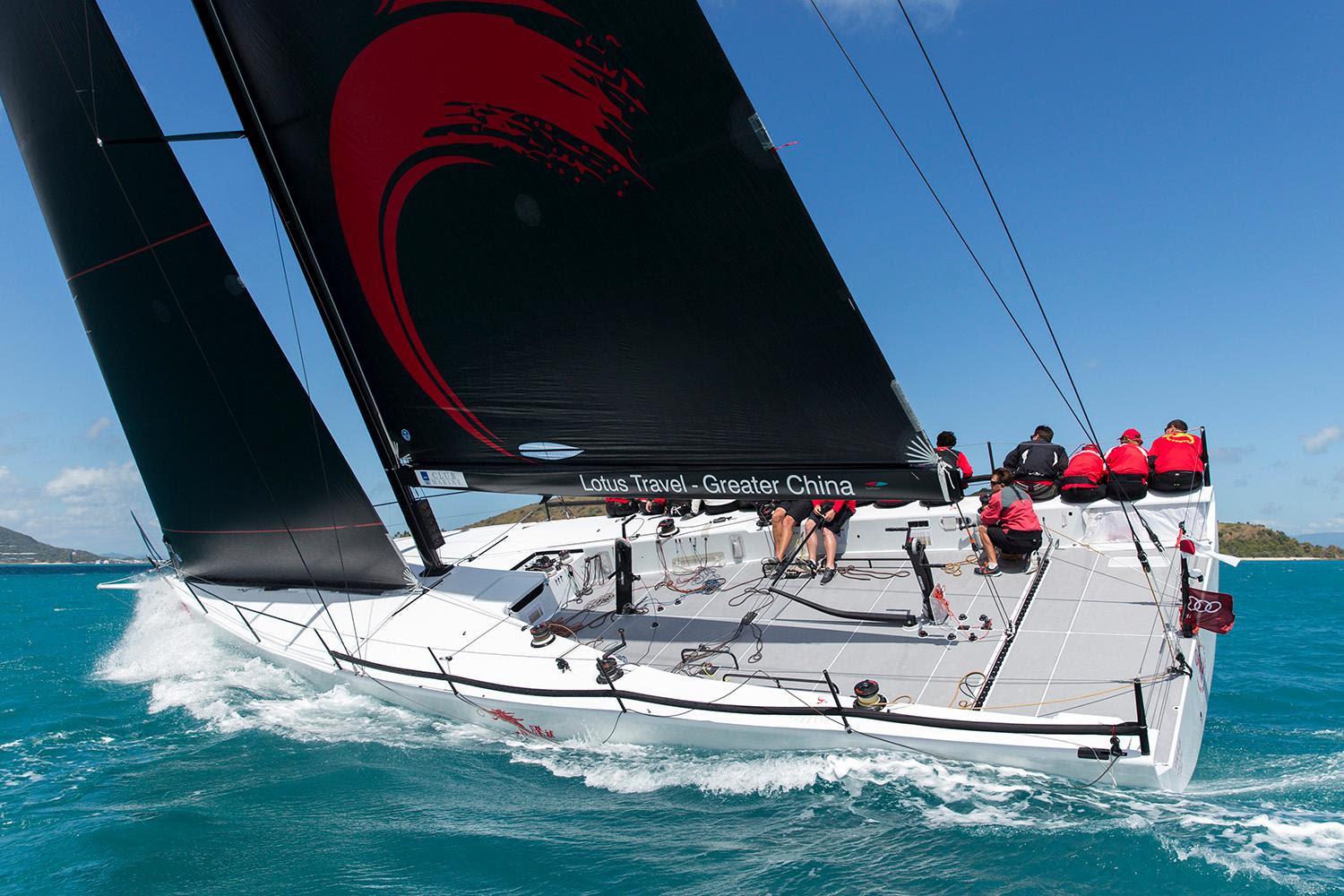
TP52 BEAU GESTE WINS HAMILTON ISLAND RACE WEEK
Kwok defends Hamilton Island Race Week title with new TP52 build, Beau Geste
As many unwind after another spectacular Hamilton Island Race Week, race crews are already gearing up for their next quest. The regatta announced four winners after the the highly competitive event wrapped last Saturday. Karl Kwok’s new IRC optimized TP52 Beau Geste won IRC A with six points to spare, ahead of Matt Allen’s TP52 Ichi Ban and Geoff Boettcher’s TP52 Secret Men’s Business. The new build was a sight to see for onlookers at Hamilton Island, and her performance did not disappoint.
“Winning Hamilton Island is special; I think this is the toughest event with the greatest range of conditions. The best boats in Australia come to it; there are no pushovers here. To win this you have to be a well rounded team with a well rounded boat,” said Gavin Brady, sailing master on Beau Geste.
For the Beau Geste crew, starting Day 1 at Hamilton Island with ‘all systems go’ was a feat in itself. Having launched the boat July 1st, they sailed two test days in Auckland with 25 knot conditions before packing the program up for AUS. Luckily, good work was done ahead of time, leaving very little to adjust once the boat was sailing. From a sails perspective, North Sails designer Magnus Doole worked in tandem with Steve Wilson at Southern Spars to create a cohesive engine above the deck.
“Beau Geste is exceptional because the project started with an established design from Botin Partners coupled with a custom structure from Pure Design, allowing us to optimize the set up for IRC from the beginning. The rig is taller than a standard TP52 and the boom is lower. With a high potential for sail area and a deeper fin, the result is a nice increase in righting moment,” said Doole, who has designed sails for the team since 2011.
Doole has spent four years developing the IRC TP52 sail inventory; most of this work was put into the sails on Jim Swartz’s Vesper from 2011-2015. “A lot of the lessons we learned with Vesper were transitioned straight to Beau Geste,” said Doole. “We put a lot into optimizing the mainsail for a wide range, and searching for sweet spots around the rule. Its all about finding the best balance between rating and boat speed.”
Now one-for-one on regatta wins, the Beau Geste crew look forward to the IRC Championship in New Zealand. “The crew have given positive feedback on the 3Di sails, their first set of North Sails 3Di RAW. We are thrilled the boat sailed well at it’s first event and will be following closely as they take on the next challenge,” Doole concluded.
READ MORE
READ MORE

DOMINATING THE TRANSPAC LEADERBOARD
It was a fantastic year for North Sails-powered teams in the 48th edition of the Transpacific Yacht Race, a 2,225-mile biennial race from Los Angeles, CA to Honolulu, HI. Winning 8 of 11 classes – including Division 1 winner Wild Oats XI, who beat the 2nd place boat on both elapsed and corrected time; overall winner James McDowell and crew on his Santa Cruz 70 Grand Illusion; and first-to-finish honors earned by Harry Zanville and his crew aboard his Santa Cruz 37, Celerity – North Sails-powered teams dominated the leaderboard and took some pretty enviable trophies home at the conclusion of the race.
Historically, the Transpac has had predominantly downwind and/or reaching conditions but this year served up more upwind racing due to a wet southerly breeze. Starters in the first fleet, on Monday, July 13, saw windy, more traditional conditions but by the third start five days later on Saturday, July 18, an adjacent tropical storm drove the fleet north to find more wind. “Early in the race tropical depressions ruled the routing!” said Zack Maxam of North Sails in Costa Mesa, CA who sailed onboard the TP52 BOLT owned by Craig Reynolds, and winner of Division 2. “Some teams dove south aggressively and early, only to get skunked as the tropical storm fizzled. The next move was to bite the bullet and blast north to gather the more traditional gains above the resident high pressure system,” Maxam continued. “Now I’m no weather expert, but I know that the shortest distance between two points is a straight line and crossing well above and below rhumbline better be worth it…maybe it wasn’t, but it was worth a shot!”
Winning Division 3 and taking home the King Kalakaua Trophy for the third time was the Grand Illusion team. Awarded to the boat with the bestoverall corrected time, Grand Illusion raced with three new sails: a 3DL mainsail, 3DL medium #1 and a North asymmetric spinnaker complementing the rest of her North Sails inventory. Sailmaker Bill Herrschaft has worked closely with the Grand Illusion team for many years. “James McDowell and his team know the Transpac course maybe better than anyone and did a bang-up job winning Division 3 and the overall trophy once again,” Herrschaft said. “Congrats also to navigator Patrick O’Brien who won the Chuck Ullman trophy for providing guidance to the overall winning team.”
North-powered teams benefitted from internal collaboration between sales, sail care and design teams based throughout North America. And while customized speedsters typically seem to take center stage and attract the lion’s share of attention these days, classically- styled Marjorie, a 59′ gem designed by Stephens Waring and built by Brooklin Boat Yard in 2007, won Class 8, following in the wake of another classic, Dorade. “Marjorie is a beautiful yacht and I really enjoy working with owner Gardner Baldwin and his crew starting with the build of the boat in Maine in 2007 to now winning her class in the Transpac,” said longtime North Sails representative and president of North Sails Graphics John Gladstone. “This year, we worked with Greg Stewart at Nelson-Marek Designs and our own sail designer Mark Taylor to be sure the sail sizes fit the split rig ketch perfectly and optimized her performance rating as we did with the 2013 Transpac overall winner (and longtime North Sails customer) Dorade. We built a new mizzen spinnaker (very cool by the way!) which ended up being Marjorie’s money sail for this year’s race,” Gladstone continued. “We all know that the bigger/faster boats usually get the most attention but the North Sails team works hard for – and we are very proud of – all our customers, regardless of boat size or type.”
“Racing onboard BOLT was a blast with the father and son team of Craig and Carson Reynolds and our rock star amateur navigator Chris Lewis, who helped get us to Hawaii in 8.5 days and win our class,” Maxam said. “We were the oldest of the three TP52s but we were equipped with a new set of North Sails including a spectacular A2.5 spinnaker designed by Chris Williams. We turned in a great performance and finished 3rd overall but, most importantly, we finished with very happy owners, which makes it all worthwhile,” Maxam continued. “I wouldn’t have had the confidence or knowledge onboard without the help and advice from several North Sails team members including fellow salesmen and Transpac veterans Eric Doyle, Bill Herrschaft, Kevin Miller, Jon Gardner and Patrick Murray, who all gave me advice they thought I could use during the race. I am also thankful to sail designers Chris Williams and Rich Bowen who answered dozens of my questions about sail selection charts and spinnaker options,” Maxam said. “But most importantly, our local sail care team absolutely dominated the pre-race preparation with Dolph Gabeler adding spinnaker stop tabs and safety orange at any hour of the day. Dolph reminded me many times that we succeed as a team by sticking to our strengths and executing our maneuvers and guess what? We didn’t have a single sail issue!”
Congratulations to all North Sails customers for another awesome showing on the 2015 Transpac leaderboard.
Full results, photos and more can be found online at: http://transpacyc.com/
READ MORE
READ MORE
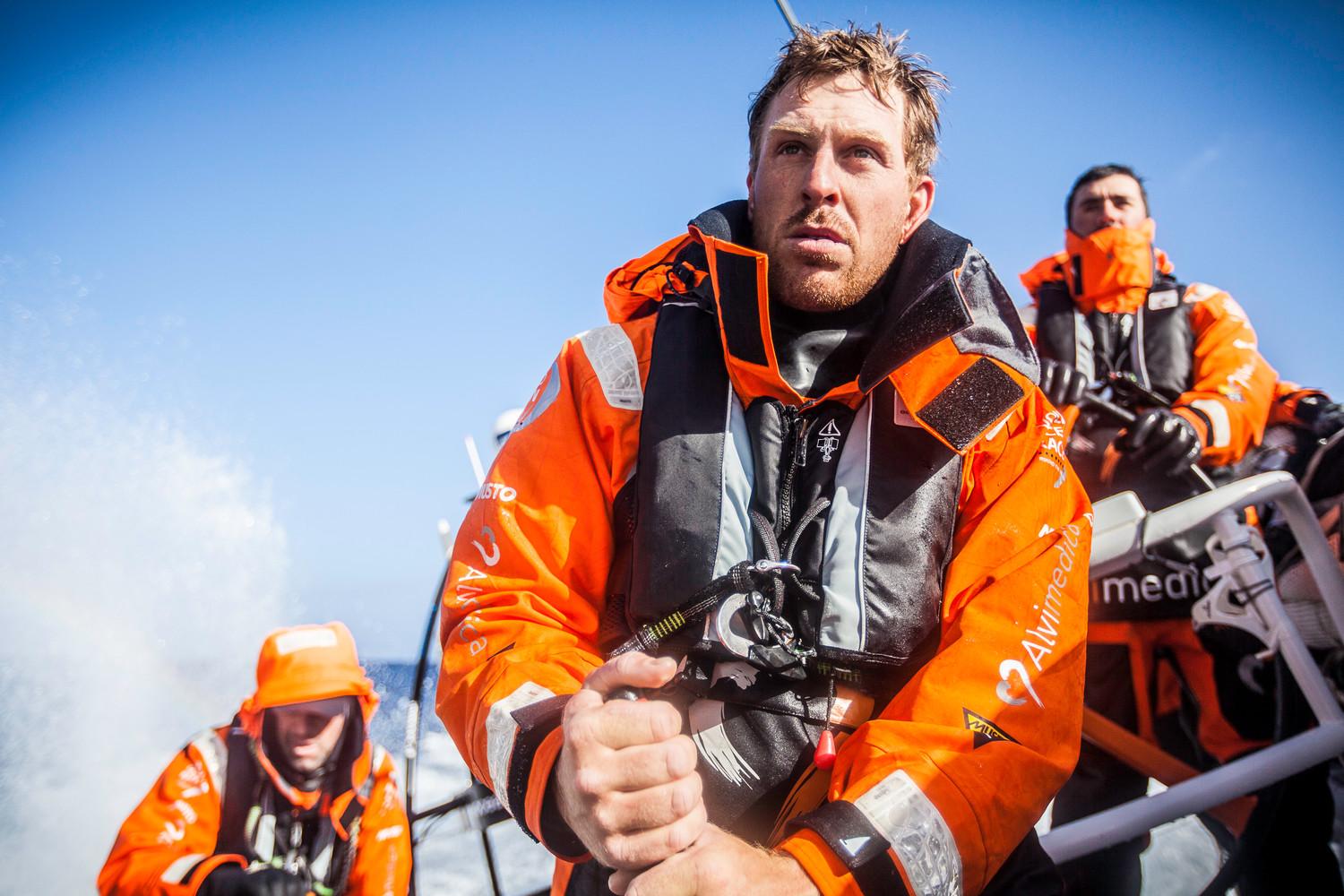
WORLD CLASS SAILOR DAVE SWETE JOINS NORTH SAILS
North Sails announced today that Volvo Ocean Race and America’s Cup World Series sailor and former North Sails sailmaker, Dave Swete has returned to North Sails as a sales representative in the UK. Originally from Auckland, New Zealand, Swete has been an onboard trimmer for two Volvo Ocean Race teams, most recently Team Alvimedica in the 2014-15 race. He has raced in almost every major offshore race during his professional sailing career and won the World Match Racing Tour in 2009 with Adam Minoprio.
“We are thrilled Dave has chosen to return to North Sails after an 8-year professional sailing hiatus that offered him many impressive experiences and victories,” said Bob Lankester, sales manager for North Sails in Europe. “He has competed in the Volvo Ocean Race twice, two America’s Cup World Series events, the World Match Racing Tour, and is a regular in the Mini Maxi 72 fleet, to name a few of his many accomplishments. He is keen to bring his experience and skills back to the North family and we are happy to have him return to our team here in the UK,” Lankester continued. Dave, commonly known as ‘Sweety’, “particularly enjoys passing his knowledge onto clients and ensuring they are having fun and getting the most out of their North sails,” Lankester concluded.
“Having sailed every leg of the Volvo Ocean Race 2014-2015 and being in charge of onboard sail repairs, I was truly impressed with how little work was needed on the sails during the race,” Swete said. “This included a North 3Di mainsail that held its shape remarkably with over 40,000 miles sailed, leaving me to believe we could do another lap of the planet with the same sail! This really opened my eyes to how special a company North Sails is, from sail design to innovative products, to the finishing touches and support network. It it an absolute honor to be re-joining such an awesome company.”
“Dave Swete is a very versatile sailor and sailmaker,” said Charlie Enright, skipper of Team Alvimedica and North Sails representative. “He is competitive and committed to excellence which makes him a great fit with the North Sails team. Because he is experienced in sail care after working at North Sails in New Zealand, he understands the bridge between sail construction and sail performance which is a very unique skill set.”
READ MORE
READ MORE

TO BERMUDA AND BACK
The Bermuda One-Two Yacht Race is a historic two-leg biennial race departing from Newport, Rhode Island to St George’s, Bermuda and back to Newport. Founded in 1977, this two-part race features single-handed racing to Bermuda and double-handed back to Rhode Island. The boat’s lengths have varied from 21-foot Mini Transat to 41 feet and the race emphasis is on safety, good seamanship and ongoing communication, according to Bermuda One-Two history. Developed for single-handed sailors looking to further their experience, as well as seek adventure with the help and camaraderie from the other single-handed sailors, this race gives skippers and crew the chance to earn awards for sportsmanship, seamanship, conquest of on-the-water adversity and sheer guts.
Single-handed sailor and winner of Class 3 in this year’s event was Brian Flynn. Flynn, who races with a complete North Sails inventory, won the single-handed leg and placed second on the double-handed trip back. He completed this race on his Islander 36, Island Girl, and has completed the 2011, 2013, and 2015 races. Brian had a few minutes to catch up with us after his impressive performance.
INTERVIEW
Q) Congrats on winning your class in the Bermuda 1-2 (the single-handed leg) and finishing second in the double-handed leg. Can you tell us a little about how/when you started sailing and what has kept you interested in the sport of sailing? Do you enjoy single-handed sailing?
A) I started sailing catamarans off the beach when I moved to Virginia Beach in 1982. I was hooked the first day. To move a boat without an engine fascinated me. To figure out how to make a boat go faster than the next person appealed to my engineering background and competitive nature. Plus it is just plain fun. I moved slowly up the ranks to bigger and better boats and by the early 90s, I was spending all of my vacation ocean racing. I even became a part-time coach at the Naval Academy. Many people that I have met along the way have become lifelong friends but despite different backgrounds, we all had sailing in common. No one cares about your background or what you do for a living, they share a passion with you and like what you bring to the boat, both in skill and personality.
I’ve held every position on a boat during crewed ocean races. Solo sailing involves you in every aspect of the boat from cooking and cleaning to sail trim and navigation. It is an opportunity to prove all of your skills. Solo sailing is about seamanship. Boat preparation, weather forecasting, routing and sleep management are all equally important. Doing well in a race is very rewarding as is shows that you understand the task at hand and that all of the hard work over the years paid off.
Q) Tell us a bit about your boat, the Islander 36. When did you buy it and how often do you race it?
“The camaraderie between the sailors is why people do this race. When in Bermuda, there are no crews, there are just other competitors. It is like joining a fraternity.”
A) The boat is an Alan Gurney design from the early 1970s and built through 1986. Around 700 were built. They were originally designed as west coast racing boats to the IOR class rule. I bought Island Girl (Islander 36 hull number 645 built in 1983) in 1992. I lived aboard and married my wife Lisa on the foredeck in 1995. From May 1996 through June 1997 we cruised her to Canada and the Bahamas homeschooling our daughter Billie throughout third grade. Island Girl sat idle for a number of years while we raised our daughters Billie and Casey and pursued career goals. I became interested in the Bermuda One-Two in 2009 and started upgrading Island Girl to race her competitively.
Q) Have you done the Bermuda One-Two before? Will you do it again? Any advice for people interested in doing the race?
A) I participated in the Bermuda One-Two in 2011, 2013 and 2015. In 2011 the race was about proving that I could sail to Bermuda solo, little else. I was in the back of the pack. In 2013 there were significant storms during the solo leg and I had equipment failures. I was happy to finish as only 16 boats made it to Bermuda after many turned back and one sank. I felt I had unfinished business to take care of in 2015. That’s why I teamed with Jonathan Bartlett and the North Sails team to upgrade my sail inventory. I was not planning on racing in 2017 but my nemesis Ray on Aggressive bet one drink in Bermuda. Now I have to do it again, damn you Ray! The camaraderie between the sailors is why people do this race. When in Bermuda, there are no crews, there are just other competitors. It is like joining a fraternity. Everyone knows what you have been through when it comes to years of preparation for the boat and yourself, and treats you like family. My best observation is that solo sailing is a test of seamanship. You have to be prepared for anything. When the going gets tough is when all the preparation pays off.
Q) Do you have any mentors or people you admire in the sailing world (specifically in the single-handed arena)?
A) I have been racing in Annapolis since the late 1980’s. I have met many impressive people who have shared their knowledge with me. I have always been like a sponge, absorbing as much as I can. I’ve raced on Maxis, 12 meters, and special built ocean racers. I may have learned the most during frostbite racing from November to March in Annapolis. Small crews bunched together in the cockpit discussing every scenario, every tactic, every sail trim. The races are short and intense with constant feedback between everyone onboard. After 20 years with the same group, you can’t help but learn.
Q) Tell us a little bit about your sails. When did you first start using North Sails and do you think they help the boat’s performance? Would you recommend North to other sailors?
A) All of the race boats that I have crewed on throughout the years have had exclusive North Sails inventories so I am very experienced with your product. Ive known Jonathan since I first moved to Annapolis and he has helped me get rides on competitive boats. When I analyzed my boats past performances, boat speed was the issue. Jonathan outfitted Island Girl with a fully battened NorDac Main and NorDac Radian cut 135% furling genoa. Island Girl is equipped with a Selden bowsprit and I use a North Sails asymmetric spinnaker with a sock. The spinnaker really gets the boat moving. I have the spinnaker system rigged so that I can drop the sail from inside the foredeck hatch a significant safety issue when shorthanded sailing. The new sails had the boat moving at target speeds in both light and heavy conditions. I had no issues despite seeing over 30 knots sustained for significant periods of time on four occasions. I was able to furl the genoa to around 40% many times while driving the boat. This is significant because it kept me off the foredeck and prevented me from having to change to a storm jib. Other boats had sails tear, problems reefing, and even maintaining control of the boat in heavy conditions. Boats split their sails on the way to Bermuda and one lost their rig on the return trip. I would definitely recommend North Sails. After 1,500 hard ocean miles (including delivery) the sails still look brand new and have lost zero performance..
Q) What else do you have planned for this season? Will we see the Island Girl doing more solo races this year?
A) I purchased a NorDac Radian cut 155% genoa for racing on the Chesapeake Bay (lighter winds, one crew). My wife Lisa and I plan on doing some double handed point-to-point races on the Chesapeake this Fall. Since the Bermuda One-Two takes almost a month to complete, from the arrival in Newport June 1 for safety inspection to the awards June 27, I have to go back to work so there wont be time to do any other solo races. The boat is still in Rhode Island, though, and we are going to try to sneak in a quick trip to Nantucket prior to returning to Annapolis sometime in August.
The North Sails team congratulates Brian on his success in the this years Bermuda One-Two and wishes him much luck in 2017.
FULL RESULTS CAN BE FOUND ON THE BERMUDA ONE-TWO RACE WEBSITE
READ MORE
READ MORE
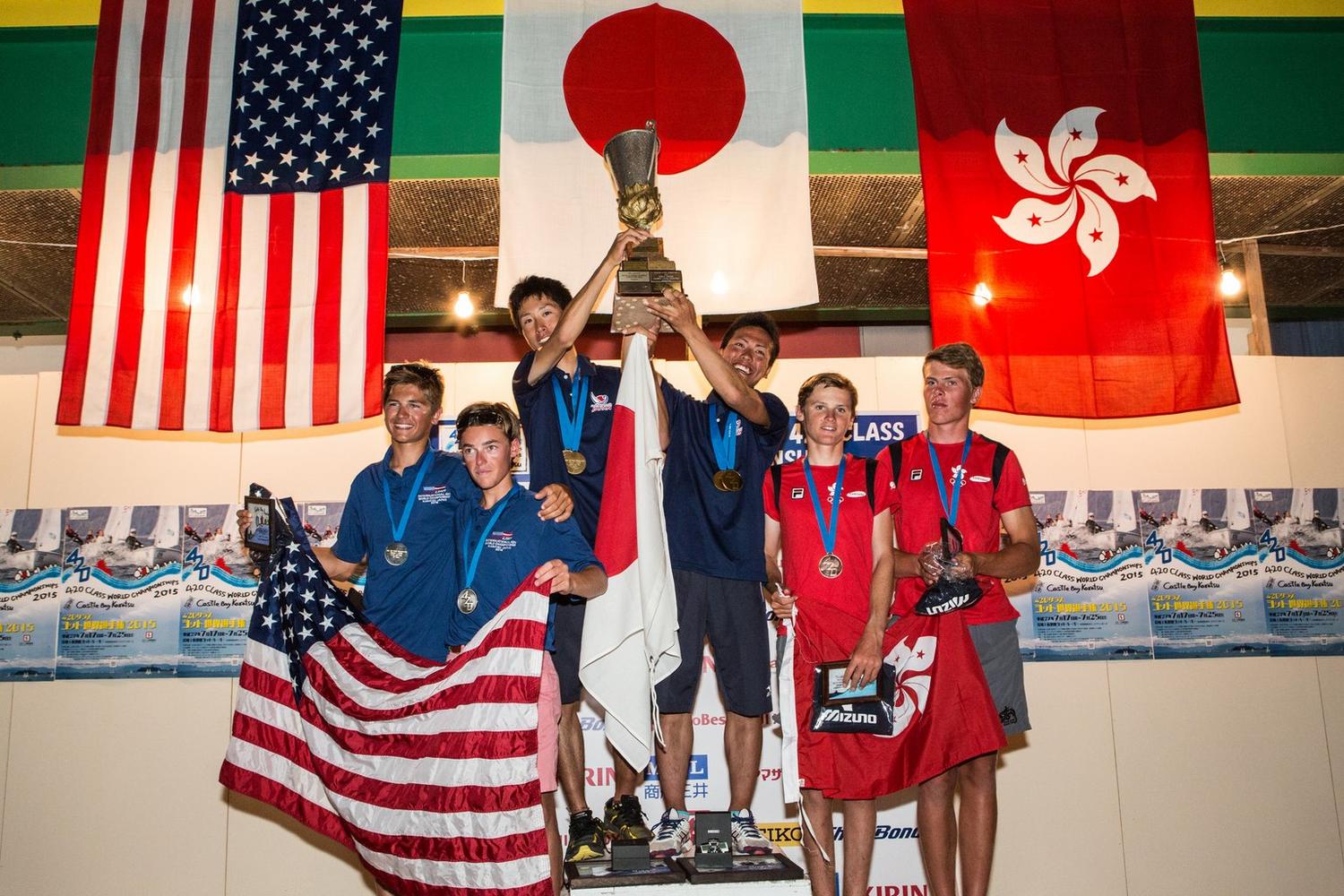
2015 I420 WORLDS: HOMETOWN WIN
North Sails-Powered Teams Win 420 Class Worlds in Japan
Congratulations to Daichi Takayama and his crew, Syota Nakano for winning the 420 Class World Championship in Castle Bay Karatsu, Japan. The duo, racing with a complete North Sails 420 inventory, sailed very well in a highly competitive regatta with 168 boats from 22 countries. “Congratulations to Daichi and Syota for a great win in their home waters,” said Kei Takakuwa, Sales Manager for North Sails One Design in Japan. “We are very proud of their accomplishment and look forward to following them on their journey to the 2016 Olympic Games,” Takakuwa said.
North Sails-powered boats also finished 3rd (Calum Gregor/Hugo Christensson / Hong Kong), 4th (Vasillios Gourgiotis/Epameinodas Orestis / Greece) and 5th (Hiroaki Kato/Takuma Yoshinaga / Japan) in the open class.
North Sails would also like to congratulate the top eight female teams, all powered by North Sails*, for taking top honors in their 60-boat division. Marta Garrido and Maria Jesus Davila from Spain took the gold medal without having to sail the last race. “The level of competition among the women’s class is incredible and we are very proud that teams using North Sails finished in the top eight places,” continued Takakuwa. “These sailors are incredible athletes and I am sure we will see many of them at the Olympic Games next summer,” he said.
Congratulations to the following North Sails-powered teams in the ladies division:
1. Marta Garrido/María Jesus Dávila (ESP)*
2. Charlotte Yven/Marine Riou (FRA)
3. Misaki Tanaka/Sena Takano (JPN)
4. Nia Jerwood/Lisa Smith (AUS)
5. Sarah Norbury/Mari Davies (GBR)
6. Marina Lefort/Lara Granier (FRA)
7. Mano Udagawa/Yuri Saito (JPN)
8. Theres Dahnke/Birte Winkel (GER)*
*-Majority North Sails inventory
The North Japan designed International 420 sails are available worldwide through the North loft network.
More information and photos visit the 420 Class Worlds Website
Photos: Jun Hirai
READ MORE
READ MORE
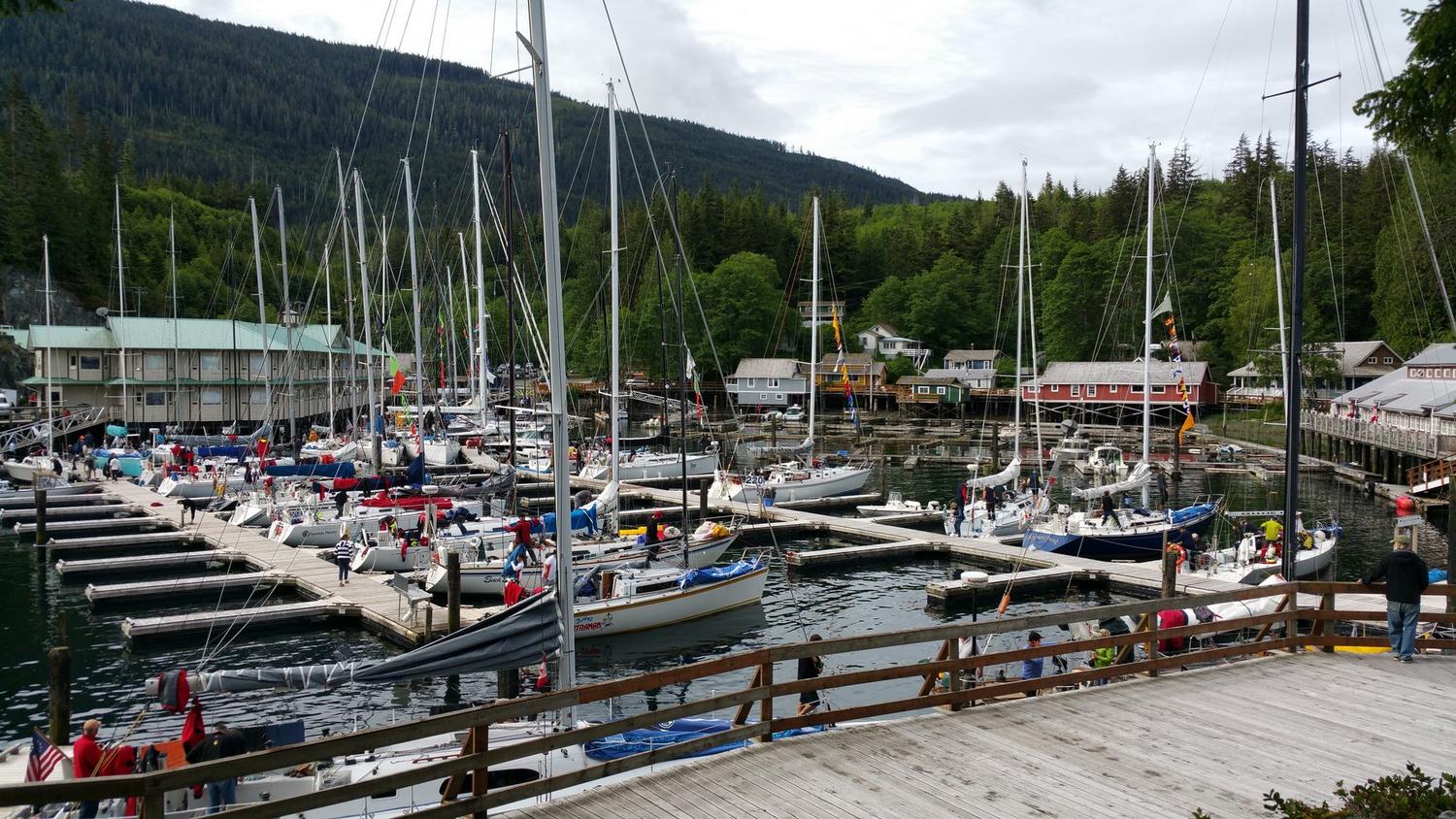
SAIL CARE ROAD TRIP: VAN ISLE 360 RACE
Chris Walter from North Sails Vancouver logs his road trip to provide sail care for the Van Isle 360 international yacht race.
This year marked the 10th Van Isle 360 International Yacht Race, comprised of nine distance legs running counter-clockwise around Vancouver Island. Known for its mild climate, mother nature delivered a whirlwind of uncharacteristically stormy weather for the sailors, who raced a combined 534.2nm between the start in Nanaimo and the finish in BC’s capital city, Victoria. Forecasts reported a maximum wind speed of 35 knots, a true test of strength for all 73 boats in the race and the wit of their crew.
North Sails is proud to have supported the race’s 10th edition through the overnight sail care program run by the Vancouver team and led by Chris Walter. Chris spent 20 days on the road, following the fleet up the inner coast of Vancouver Island and around the outside, taking in repairs each day and fixing them in time for the boats to reach starting line the next morning. With help from trusted accomplices and the occasional break to sail, Chris took a few minutes each day to record his journey for us.
37.4 NATUTICAL MILES, WIND SPEED 17-23 KNOTS
LEG 1- NANAIMO TO COMOX: ON THE ROAD
1030: I watch as the fleet pushes off the docks of Nanaimo, “The Harbour City” as it’s known, to begin their circumnavigation of Vancouver Island. It was a downwind start out of the bay and into the Strait of Georgia where they were greeted by a strong northwest wind.
1100: I hop in the van and begin the drive to Comox. I took the Old Island Highway for a more scenic route, stopping along the way at parks and trying to catch a glimpse of the boats. Eventually the wind started to die and I left the fleet behind to join the rest of the road crews at the park in Comox.
2000: It was late in the evening before the first boats started to arrive at the docks . When Zulu (a custom Jesperson 42 that I sail on quite a bit) arrived to the dock with our crew of Findlay Gibbons, Trevor Gibbons, Peter Gibbons, Krizia Marban, Reigh North, Rick Wunderlich, Andrew Costa, and Drew Mitchell, I caught their lines and spent some time on the boat before we all went to bed. I was excited to race on Zulu the next day in the inshore Straight Marine Race.
WIND SPEED 9 KNOTS WITH GUSTS TO 15 KNOTS
JUNE 7 – STRAIGHT MARINE RUM RACE: ZULU
0715: I am woken up by Drew bringing a genoa from Family Affair, a Beneteau 45, to the van to repair a tear along the top of the spreader patch. Once I found the right supplies, I got the sail patched up just in time to head out for the race start.
1100ish: The Straight Marine Rum Race race was held on Comox Harbour and consisted of a windward leeward course with the finish just off of Goose Spit. It was a fun race where every boat was awarded a bottle of rum at the beer garden later in the afternoon. Today was extremely hot with a period of very light wind, even the water was quite warm but everyone went swimming anyway. After racing, I got to work replacing all the battens in Northern Light’s jib (they had all flown out of the sail during a tack), and then replaced a broken mainsail slide for Rogues Roost. With all the work done it was time to join the guys on Zulu for some dinner.
26.7 NAUTICAL MILES, WIND SPEED 11-20 KNOTS WITH GUSTS TO 24 KNOTS
LEG 2, COMOX TO CAMPBELL RIVER
ON THE ROAD-
0800: Watched the fleet start into a strong NW wind, then continued driving up island. I passed by the Comox Canadian Forces Base where the search and rescue teams are based and continued north for most of the day arriving at the Campbell River Waterfront only an hour ahead of the leading boat, a Formula 40 catamaran named Dragonfly.
2000: The finish line was just off the pier where I watched as the fleet flew across the line in what must have been 4-5 knots of current. There were only a few minor repairs today and Drew gave me a hand to get everything done quickly. Everyone was in bed early because the boats would be leaving the dock at first light to make it through Seymour Narrows at slack water, before the current really got moving. Seymour Narrows has some of the strongest currents in the world.
34.2 NAUTICAL MILES, WIND SPEED 10-16 KNOTS WITH GUSTS TO 21 KNOTS
LEG 3, CAMPBELL RIVER TO HAWICK ISLAND (AKA “FISH FARM”)
ON THE ROAD-
Lay day for me. Went hiking with my dad up to Elk Falls. Elk Falls is a 27 metre waterfall on the Campbell River, below the John Hart Dam and above the generating station.
Fish habitats have been built up and down either side of the river below the Falls for salmon to spawn in. Tomorrow I will head to the airport to pick up a new set of sails for Julien Sellgren on Kiva.
41 NAUTICAL MILES, WIND SPEED 17 KNOTS WITH GUSTS TO 25 KNOTS
LEG 4, HARWICH ISLAND TO TELEGRAPH COVE
ON THE ROAD- I drove the 212km up to Telegraph Cove from Campbell River. The road leaves the coast and heads inland through the mountains.
1300: I arrived in Telegraph Cove which I learned is an old whaling village tucked into a tiny cove. The road crew from Dominatrix had rented a house on the hill where we could watch the boats finish. Neptune’s Car was the first to arrive and we saw they were motoring, so they must have had a breakdown, followed by the other Santa Cruz 70 Westerly, the Formula 40 Dragonfly, and another catamaran named Bad Kitty. By this time, there was already work to do as Neptune’s Car had torn the leech in their mainsail and lost some battens. I assessed the damage, took the sail with me, and the other jobs started flooding in.
…We took in four mainsails and many jibs with damage all down the leech from the strong wind the fleet had been sailing into for the past few days. I was up until 11pm fixing sails before a heavy fog rolled in and stopped us from working for the night. We couldn’t get them all done but we had been sure to finish the mainsails first so that every boat could sail the next day. The next morning I headed down to check out the fleet all crammed into the tiny cove. It was quite impressive to see them all fit, I had my doubts the day before!
LEG 5, TELEGRAPH COVER TO PORT HARDY
ON THE ROAD- 1330: Arrived in Port Hardy just as the first rain started to fall. After re-provisioning the van, I am waiting for a sail and more supplies to be sent up from Vancouver. It started to rain hard, off and on all day, as the fleet slowly trickled into to the bay across the finish line. With many sails to repair we were lucky when the local Harbour Master gave us a room in their building to work. Protected from the rain, we set up our mobile loft and Drew, my dad, and I got to work fixing sails. I worked until 2am, when every job was finished. I wanted to get everything done so I could go out on the boat the next day.
69.1 NAUTICAL MILES, WIND SPEED 8-21 KNOTS WITH GUSTS UP TO 30 KNOTS
LEG 6, PORT HARDY TO WINTER HARBOUR
Onboard ZULU – This leg was around 70 nautical miles and took us around the top of Vancouver Island. With the start line at the bottom of the bay the fleet didn’t have much room to play with and we didn’t get the best start. We headed out of the bay on a close hauled course, tacking up the inside and then crossing the Nahwiti Sandbar which was quite interesting with so many breaking waves. Once through the bar, we were able to start cracking off and picked up speed as we headed to Cape Scott at the tip of Vancouver Island. After a nice run down the outside, we turned the corner into Winter Harbour just before sunset.
JUNE 13
WINTER HARBOUR LAY DAY
Winter Harbour is a tiny community on the west coast of Vancouver Island. There is an old boardwalk that runs along the waterline between the homes and the ocean, and one storefront that opens only when they feel like it. I spent most of the day repairing the last of the sails from the upwind legs and finished in time to miss the barbecue. Lucky for me, they fired it up again so I could get some dinner! After that Drew and I and a few others walked down to the beach and around the corner from town. We had a fire and enjoyed how peaceful it was to be out in the middle of nowhere. As it started to get dark, we headed back to the party where the guys from the Formula 40 Dragonfly put on a fireworks show for everyone.
138.1 NAUTICAL MILES, WIND SPEED 20 KNOTS WITH GUSTS TO 30 KNOTS
LEG 7, WINTER HARBOUR TO UCLUELET
ON THE ROAD – 0740: I jumped back in the van just as the fleet left the dock. The drive started with two hours down a narrow logging road that, in some places, you couldn’t pass a car if you met one. Lucky for me, it was Sunday because you can’t drive on these roads during the week days until evening due to active logging. Back on the highway, I still had a long way to go – all the way down to Parksville, then take a right to pass through Cathedral Grove. The grove is one of the only old growth forests in BC you can drive through. The trees are huge. The road took me up over the hill to Port Alberni where I stopped for gas and food before continuing down the narrow winding road out to Ucluelet and Tofino. I barely had time for dinner before rushing down to Amphirite Lighthouse to watch the boats finish Leg 8. Out on the horizon I could see Dragonfly finishing just as the sun was setting.
JUNE 15-16
LAY DAYS
Headed up to Tofino and went surfing for a day at Cox Beach. It was nice to relax. The next day, a bunch of local school kids came down to check out the boats and ask lots of questions. They even got to help out with tasks on some of the boats. On Zulu we gave the kids some North Sails sunnies and they were all very excited. Later we walked down to the awards dinner, then back to the boat for the start of the next leg in the morning.
98.2 NAUTICAL MILES, WIND SPEED 9-18 KNOWS WITH GUSTS TO 35 KNOTS
LEG 8, UCLUELET TO VICTORIA
Onboard ZULU – We headed out of the harbour to the start line and were greeted by a very light Northwest Breeze. The wind picked up just as we were about to start and before I knew it we were off with the big boats leaving most of our competitors behind. We had steady breeze all day and the sun was out. We made a few gybes and took a nice header that had us flying down into the Strait of Juan de Fuca alongside Strait Marine, a Farr 40, and Jam a J/160. After going as far to the American side as we wanted, we gybed back to the Canadian side of the strait. As we expected, the wind began to pick up closer to Race Rocks on the Canadian side, so we gybed again and doused the big kite. We hoisted the heavy air spinnaker and blasted back across the passage with a top speed of 16.7 knots – not far off Zulu’s all-time speed record.
Soon we had to gybe again and in the heavy breeze we tore the kite through the turn, so we took it down quickly to avoid further damage. As we headed into Race Passage (between Race Rocks and Vancouver Island) the wind really picked up to at least 30 knots gusting to 38, with the tide running against us at 4.5 knots. The sea state was a mess and we were surfing down waves at over 15 knots boatspeed with the bowsprit buried in the back of the next wave. The boats behind us rounded up under main and jib and one was still coming down under spinnaker. I noticed they made the wise choice to get rid of it before they approached Race Rocks. We took it easy as we knew we were probably far enough ahead and the wind was still quite strong. Closer to the finish at Clover Point we hoisted the big kite and passed a boat in the 1st Division before finishing. We were greeted by Krizia at Royal Victoria Yacht Club with three pizzas and beer.
DAY 12
VICTORIA LAY DAY
Spent the day cleaning up the boat and stripping everything that we didn’t need for the last leg. We even took the cooking spices off the boat. We had to beat two boats ahead of us (Kiva and Different Drummer) that were tied for first on the leaderboard in our division. Drew and I and some of the crew showed a friend from Nova Scotia around Victoria as it is a very cool place that has a very British feel to the downtown part. In the evening there was a bbq and prizes in the rain.
59.9 NAUTICAL MILES, WIND SPEED 6-12 KNOTS
LEG 9, VICTORIA TO NANAIMO
ZULU – 1200 start today: The final leg was very challenging as there are so many different route options to take between the islands. We were prepared and planned our route in advance using the forecast as a guide. It was a downwind start in 20-25 knots and we sailed our planned route through Enterprise Channel between Vancouver Island and Trial Island which is only about 600 feet wide at its narrowest part. We were one of the first boats through with a good chunk of the fleet cramming in behind us. They didn’t look like they were having fun! As we headed out into Haro Strait the wind started to calm down and temperatures rose. We noticed that a number of bigger boats were well inside kelp reefs when, all of a sudden, Neptune’s Car stopped dead in the water. By the time they were off the reef and back into deep water we had almost caught up to them.
As we gybed close to Sidney Island and the kite filled I noticed a three foot long tear coming out of the clew patch and up into the middle. We rushed to rig up the smaller heavy air kite and drop the big white one down before it tore any more. After a quick repair on deck we had the white kite back up again. Later on as we approached Saltspring Island and sailed into Captains Passage we watched a number of other boats head north toward Active Pass. We had already chosen our route and stuck with it. We were now in Trincomali Channel and had a big transition zone to get through. Unfortunately we were on the wrong side and a few other boats snuck past. Once through the zone we got the code zero out and had a nice reach down to Porlier Pass. With the tide still flooding, both Zulu and our competitors were spat out into the Strait of Georgia. On Zulu we were spun right around by a whirlpool as another boat was pushed to close the shore and ran aground.
No wind in the strait. We all let the current push us up the side of Valdes Island toward the finish. Out farther in the strait you could see Darkstar just barely make out ahead of the rest of the boats who had followed them. We were waiting for the wind to fill so I went up the mast to have a look and see if any wind was coming. The crews on the other boats were watching me and when I got to the top of the mast I said “nope, we are screwed” quite loudly and everyone around us had a good laugh. By this time the sun was going down and there was still no wind. Yet somehow the sneaky little J/80 SW2 had managed to sail past us and they just kept going. A round of coffee and hot chocolate and the wind started to finally fill in. We didn’t have far to go now, Just around Gabriola Island and into Nanaimo Harbour, trading tacks with other boats in the dark. We went between Entrance Island and Gabriola Island on our last tack, heading right for the south end of Protection Island on a close reach. Then we rounded up to close hauled and crossed the finish line.
Congratulations to all Van Isle 360 sailors and the organizer and supporters of this event. It was well-run and it seemed everyone had fun and enjoyed the beautiful Vancouver weather and scenery. We hope to see you all again next year!
READ MORE
READ MORE

HISTORY IN THE MAKING
North Sails Kicks Off the Week With Star Studded “History in the Making” Panel
Gusts up to 30 knots kept sailors ashore on the first day of the Bicentenary Int’l Regatta, but sailors’ patience was rewarded tonight with a fun & interactive panel discussion featuring Americas Cup skippers Jimmy Spithill and Sir Ben Ainslie, and skipper of the all-female Volvo Ocean Race Team SCA, Sam Davies.
As temperatures cooled, Cowes Yacht Haven quickly filled to the brim with sailors eager to hear from the best in the sport.
North Sails President Ken Read led the group in a discussion of sailing today including themes of technology and innovation, teamwork, and fostering enthusiasm in young sailors.
“I’m very proud and humbled to be here with three of the most valuable people in our sport. Tonight is an example of how approachable sailing is. It’s truly a remarkable sport.”
– Ken Read, President of North Sails Group & Skipper of Comanche
“On Saturday we sailed out of the harbor into a sea of spectator boats and a shore full of fans. We were amazed. It was just a fantastic day. We are excited for the future of the Americas Cup.” – Sir Ben Ainslie, Team Principle & Skipper, Land Rover BAR
“I’ve never left for a race unprepared. That gives me the confidence to push the boat hard.” – Sam Davies, Skipper, Team SCA in the Volvo Ocean Race 2014-15
“We want to build a great and sustainable event, that provides opportunity for youth to raise up the ranks. Young sailors must be athletes who look ahead and anticipate the next step”- Jimmy Spithill, Skipper Oracle Team USA
READ MORE
READ MORE
TWO AFLOAT: SV NAMOA'S JOURNEY CONTINUES
“Like everyone who chases the horizon, we are sailing into the unknown. That’s what adventure is and we’ve learned that if you embrace that fact, if you surrender to it, your life will change.”
From San Diego we voyaged down the desolate wild barren Pacific coast of Baja Mexico. We rounded the cape and bashed our way up into the striking anchorages and brisk winds of the southern Sea of Cortez. From there we reached downwind to the tropical jungles and authentic culture of mainland Mexico before eventually staging in Bandaras Bay, with many other cruisers making final preparations for the nearly three thousand nautical mile open ocean passage to the Marquesas Islands.
It took us just over three weeks to complete the crossing to the Marquesas. It was every bit the life changing adventure we imagined it would be. Once we arrived in the steep green mountains and deep valleys of the Marquesas, we rested and explored before setting sail for the Tuamotu Islands, a remote chain of atolls with a well deserved reputation for extremes – ship crushing reefs and postcard perfect anchorages, including the one where our hook is currently set. From here we plan to set course for the Society Islands and beyond.
A genetic disease called FSH Muscular Dystrophy is weakening muscles throughout my body but it never weakened my dreams of crossing oceans or my resolve to chase those dreams. I am smiling now as I write this from a remote anchorage deep in the South Pacific Ocean having put almost ten thousand open ocean miles under our keel.
“Ultimately all you need is a solid boat, good sails, and the courage to discover what happens when you sail into the unknown.”
North sails drive our boat, the key to experiencing the blazing sunshine, energized salt water, brisk winds, and open-ocean adventures that only a sailor can understand. Ultimately all you need is a solid boat, good sails, and the courage to discover what happens when you sail into the unknown. It’s good to have you aboard!
READ MORE
READ MORE
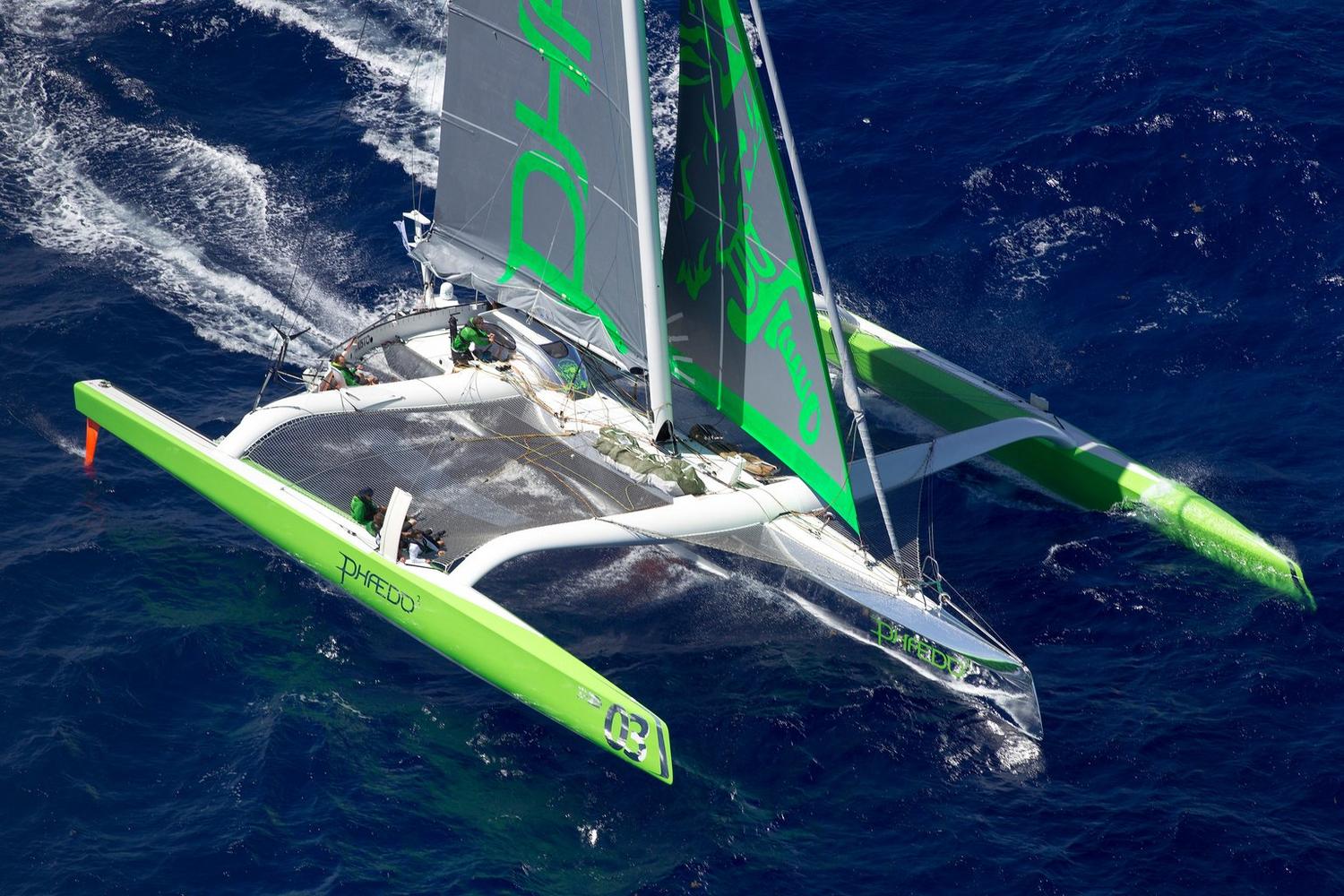
PHAEDO: NEW TRANSAT RECORD
Phaedo reaches the Lizard in record time to complete the transatlantic race 2015.
As originally reported by the Transatlantic Race 2015:
While Jim Clark and Kristy Hinze-Clark’s 100′ maxi Comanche set a new monohull 24-hour record when she covered 618.01 miles over Friday-Saturday (subject to ratification by the World Sailing Speed Record Council), Lloyd Thornburg’s MOD70 trimaran Phaedo also put in a resounding performance.
Towards the end of the race Phaedo, at one point, recorded a peak speed of 41.2 knots when navigator Miles Seddon was driving. As Thornburg recounted: “The sea opened up before him. It was the biggest wave you have ever seen and we were pointing down it!” But it was the consistently big daily runs that were most impressive – four days at 610 miles/day and this was despite a generally short wavelength that required them to stack everything hard aft and have appendages and rig raked back to the maximum setting.
While Thornburg competed in the Transatlantic Race 2011 on board his Gunboat 66 catamaran, his crossing this time in the MOD70 was an entirely different experience. “It was intense, like a time warp – it felt like four weeks at sea on any other boat all compressed into seven days. It is incredible; the boat is pure Formula 1,” he enthused of his team’s first race across the Atlantic with their latest yacht. “One of the hardest things was trying to live on board, which is a challenge psychologically and physically, day after day of slamming into waves, and with all the acceleration and the deceleration.”
As testament to what a phenomenal boat the MOD70 trimaran is, according to skipper Brian Thompson, they broke nothing on the crossing despite the furious pace. Including a day and a half being becalmed, Phaedo’s crossing time of 7 days 2 hours and 4 minutes is not exceptional, but nonetheless establishes a new multihull race record, substantially faster than the previous Phaedo’s time of 12 days 15 hours 42 minutes and 58 seconds set in 2011.
READ MORE
READ MORE
TWO AFLOAT: RYAN AND NICOLE'S STORY
Hailing from San Diego, CA, Ryan and Nicole Levinson tossed their lines last December in pursuit of adventure, and have since chased over 10,000 nautical miles of horizon.
We were lucky to meet Ryan Levinson through our local San Diego North Sails rep, Patrick Murray, who spoke of Ryan and his wife Nicole’s contagious energy and stubborn determination to achieve their life-long dream of traveling the world by sail. From San Diego, the pair made their way down the coast of Mexico before reaching the Marquesas Islands by way of a 3,000nm ocean crossing, and are currently anchored in the Tuamotus Islands.
“A sailboat needs wind like dreams need courage and when you have enough of both the adventures are endless.”
Resilience and a thirst for adventure are central to Ryan and Nicole’s incredible story, which draws back to a life-changing day in 1996 when Ryan’s doctor diagnosed him with FSH Muscular Distrophy. He met that challenge face-to-face, and has been relentless in his pursuit of experience ever since. Numerous athletic accomplishments have pushed him into the limelight, emerging as a local inspiration in Southern California and the world. The series Two Afloat will take you aboard SV Naoma to experience the journey with Ryan and Nicole, through their first hand accounts of plotting a course across oceans, to peaceful exotic respites,
and the sheer thrill of being at sea.
READ MORE
READ MORE
VIDEO: SNIPE TIPS WITH RAUL RIOS
SNIPE TIPS FROM RAUL RIOS
Video-interview after winning the 2015 Nationals at Mission Bay Yacht Club
TUNING NUMBERS:
PREPARATION:
COMMUNICATION CREW-SKIPPER:
NORTH SAILS:
READ MORE
READ MORE
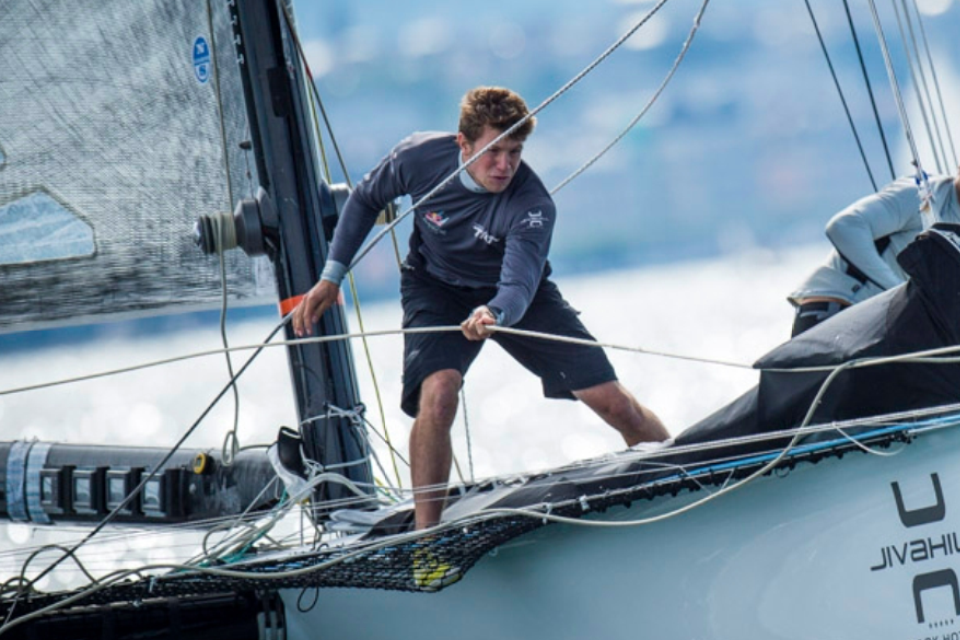
NEWS - "INSIDE NS CH" - ZOOM SUR JONAS SCHAGEN
"INSIDE NS CH" - ZOOM SUR JONAS SCHAGEN
Après Arnaud 'Psaro' qui a ouvert cette nouvelle rubrique au coeur du Team North Sails Suisse, c'est avec Jonas Schagen, marin et maître-voilier que nous vous proposons de poursuivre l'immersion...
Prénom / Nom - Surnom :
Jonas Schagen - "Joe"
Année d'entrée dans le groupe North Sails :
Septembre 2010 à Cape Town en Afrique du Sud
En 140 caractères, comment décrire votre job avec des mots simples ?
Je suis le Karl Lagerfeld de la voile ! J’effectue des réparations et je finalise toutes les voiles de D35 de A à Z. Il m’arrive aussi d’utiliser mes talents d’artiste en peignant des logos.
Plutôt croisière ou régate ? Un palmarès ?
J’apprécie les deux mais je fais beaucoup plus de régates, notamment en D35 depuis 3 ans.
Champion de série en Luthi 8.70
4e de la Red Bull Youth America’s Cup
6e du dernier Vulcain Trophy
Une anecdote depuis que vous travaillez chez North Sails ?
Vu que nous sommes 4 à faire du D35 au sein de la voilerie, celui qui gagne un Grand Prix doit apporter une forêt noire le lundi. Depuis, Pierre-Yves a une carte de fidelité au rayon gâteaux de la Migros ;-)
Et mis à part North Sails, une autre passion dans votre vie ?
J’adore le hockey sur glace et je joue au inline hockey (très similaire au hockey sur glace mais avec des patins à roulettes).
Après les portes monnaies et les ceintures en voiles recyclées, quel pourrait être le prochain nouveau produit "made by North Sails"
Des hamacs, pour ma pause de midi entre autre.
Votre plus beau projet professionnel pour 2015 ?
Team Tilt. Avec l’arrivée d’Arnaud dans notre équipe, la saison s’annonce belle.
READ MORE
READ MORE
WORLD CHAMPION SAILOR FEDERICO MICHETTI JOINS NORTH SAILS
North Sails is pleased to announce that world champion sailor and CEO of Melges Europe, Federico Michetti, has joined North Sails as a performance advisor. Michetti will play a key role within North’s Class Sail Development (CSD) team and will be a leader and class expert for the Melges 20, 24 and 32 classes.
Based in Milan, Italy, Federico has spent his entire life sailing and has won five Melges 24 World Championships; two Melges 32 World Championships; and two ILC World Championships. He is also a two-time winner of the Farr 40 European Championship and three-time winner of the Melges 24 European Championship just to name a few of his sailing accomplishments.
“I have spent my whole life racing with North sails and my mentors and best friends all work with North so it is a natural choice for me to now join the North Sails team. I look forward to bringing my sailing knowledge and experience to the table to help improve sail designs and tuning guides for the Melges 20, 24 and 32 classes to start with,” said Michetti. “I am also excited to work closely with North customers to be sure they understand the superior technology that goes into every North sail built.”
“Federico is a well-known sailor among the Melges and one design circuits and has a proven track record, winning multiple world and European championships which makes him a great asset to the North Sails team and to our customers,” said Paul Westlake, head of Global Sales for North Sails. “In addition to working for Melges Europe, Federico has been team manager for many high profile programs and is currently the project manager and trimmer onboard the Maxi 72 Robertissima III. We are thrilled that Fede has decided to join the North team,” concluded Westlake.
READ MORE
READ MORE
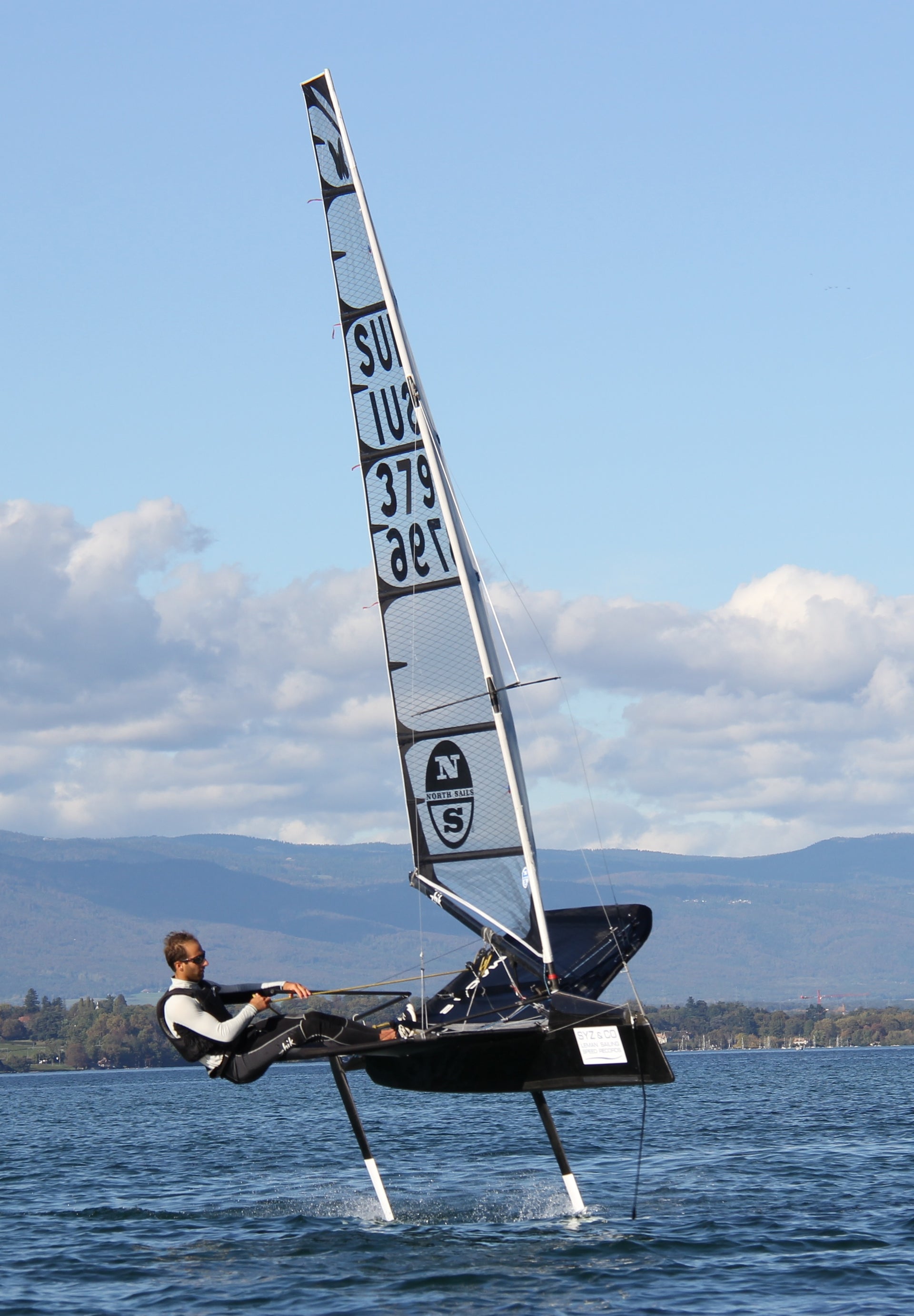
NEWS - "INSIDE NS CH" - ZOOM SUR ARNAUD PSAROFAGHIS
"INSIDE NS CH" - ZOOM SUR ARNAUD PSAROFAGHIS
Nouvelle année, nouvelle rubrique, plongez au coeur du Team North Sails Suisse.
Pour lancer la série de portraits "Inside NS CH", zoom sur Arnaud Psarofaghis, navigateur talentueux et dessinateur de voiles.
Prénom / Nom - Surnom :
Arnaud Psarofaghis - "Junior"
Année d'entrée dans le groupe North Sails :
Octobre 2005 ( à Cape Town)
En 140 caractères, comment décrire votre job avec des mots simples ?
Dessinateur de voiles, suivi qualité lors de leur fabrication sur le plancher et en majeure partie sur l'eau pour les tester et régater bien sur.
Plutôt croisière ou régate ? (avec 3 lignes de votre palmarès si régatier)
Clairement régate ! C'est sur les Grands Prix en multicoques ou sur mon Moth à foil que je prends le maximum de plaisir.
Ces cinq dernières années, j'ai d'ailleurs navigué sur les trois circuits majeurs de multi (D35, Extreme 40 et AC 45).
Dernier titre remporté ?
Pour changer, c'était à terre que l'on m'a décerné le titre de Marin Suisse de l'année 2014.
Une anecdote depuis que vous travaillez chez North Sails ?
Je suis l’expert des gâteaux type forêt noir !!! Mes collègues sauront de quoi je parle, les curieux n'auront qu'à me demander pourquoi !
Et mis à part North Sails, une autre passion dans votre vie ?
Naviguer le plus possible !
Après les porte monnaies et les ceintures en voiles recyclées, quel pourrait être le prochain nouveau produit "made by North Sails" ?
Les trampolines de Moth confectionnés par Jonas et moi ! Jonas travaille sur le plancher sur la confection, réparation et finition des voiles.
Votre plus beau projet professionnel pour 2015 ?
Le projet Team Tilt
© Jean-Pierre Baudet
READ MORE
READ MORE
J/24 FAQS
J/24 FAQs
A compilation of questions and answers we have received over the years.
What’s the recommended tension for the backstay?
With regards to the backstay, we think that having it off to measure would make it easier to get a method where all boats could be tuned the same.
With that in mind we suggest (this is in the tuning guide) that the tension on the backstay bridle always be adjusted so the blocks sit about 8″ below the triangle that joins everything together.. So each time you tighten or loosen the shrouds for a change in wind velocity you will need to do the same for the backstay bridle.
Can you give me some hints on how to go faster on a J/24?
It is really important to sail at max weight 882 lbs. In anything above 10 kts, that extra weight is noticeable in terms of upwind performance. At the top of the fleet, we try really hard to make sure we are max crew weight.
Changing gears in the J/24 is huge! The skipper has a lot on his plate. The top guys make the skipper responsible for the backstay, traveler, mainsheet, genoa trim and steering the boat. Let me try to explain how this works. A nice steady breeze makes it a lot easier obviously. In the steady breeze you can kind of get things set up and just rumble. In a puffy breeze, there is a constant adjustment of the controls.
You want to start by getting your boom at centerline. You accomplish this with mainsheet tension and traveler. The mainsheet tension controls the amount of twist in the sail and leech tension. In light air or light spots, you want twist (and the top leech tell tale flying) so softer mainsheet tension and a higher traveler to keep boom at centerline. A twisty main is also good for accelerating or for bow down modes. You want nice twist in your main after a tack to help the boat get back up to speed quickly. In medium breeze, you want a tighter mainsheet to close the leech a little for better pointing. You have to ease traveler down to keep boom at centerline if you pull on mainsheet tension. The only time you let the boom go below centerline and go traveler down is when you really need to de-power and keep the boat flat. Even before a lot of traveler down, I am usually putting on some backstay to de-power.
The backstay has a few rules of thumb. Take some off for more power and pull some on to de-power. If your main starts to invert and flog, you should ease some backstay to get flow over the sails going again. Backstay is more of a macro adjustment unless it is really puffy, then you are constantly easing it off in the light spots. Also, if you are ever overstood in breeze and need to crack off, put lots of backstay on. If you need to point higher in a short distance like if you understood the windward mark, take backstay off.
The genoa trimming by the skipper is key. Basically the skipper sits right next to the winch that has a winch handle in place. In a puff the trimmer, who is hiking out all the way, will ease the genoa in anticipation of the puff, not letting the boat heal over (we’re talking like a foot or more of ease at times), and then the skipper winds the winch handle to crank the sail back in before the boat heals to windward. This takes some practice, but once you get it, it’s huge. Never let the boat heal to leeward. Anytime the boat is healing it is sliding sideways a lot faster than you think. When a 30 knot puff hits, you actually have better VMG if your boat stops dead in the water and remains flat, than if you heal over, go forward but slide sideways. The boat that stopped dead in the water will actually be closer to the windward mark after the exchange.
How often do we get new sails? The Genoa obviously takes the biggest beating. After only a couple heavy air regattas you will be able to notice a performance difference between a new and used sail. It’s not only the beating the sail takes against the mast in tacks, but also the crew stuffing it up on the bow during downwind sailing. You might not like to hear this but we make sure we have a new Genoa for every big event.
What do I do when a puff huts?
Puff hits…crew eases genoa, skipper eases traveler.
Puff begins to ease up,skipper pulls traveler back up, cleats it. Then moves quickly to the winch handle and cranks in the genoa.
Repeat the above sequence with each new puff.
There are different variations of this depending on-strength of the puffs. If the puffs are very strong…vang sheeting-becomes a little more effective. A super tight vang and using the process above, but instead of easing traveler down, you’re easing mainsheet.
The backstay should be set as close to a happy-medium as possible, but every now and then it should be adjusted based on the overall trend of the breeze. I like to have it eased in the light spots as much as possible, as long as you can get enough back on before the next big puff hits.
It would be nice to have three hands. Trust me it is not easy…it takes a lot of practice.
I’ve been told J/24’s roll tack easy enough. Using techniques I adapted from dingy racing and a basic knowledge of hydrodynamics, I tested this theory and couldn’t get it to roll over. Is there a better technique for fixed keels that i don’t know about?
Roll facing out and push down on the windward life line. Start from the middle of the boat and do it all together. With four people rolling you should be able to get the windward rail all the way down to the water, once it is flatten the boat slowly and you will get a nice squirt forward.
What is your opinion about having multi color sails. I read somewhere that it was better to have one color due to the stretch in the panels over time. Is this a big issue?
We highly suggest having the head and clews of the sail each a solid color. Also I would try to have these areas lighter colored if possible. This way the top and bottom of the sail is made from the same lot of cloth and it will stretch relatively evenly over the life of the sail. Also making the sail with lighter cloth in the top and bottom will insure that you are getting a sail made with Grade A woven cloth. With darker colors flaws can be hidden and even though all the cloth is tested by the maker and us this generally seems a safer bet.
The tuning guides tell me about which ring to fly the pole from but as the wind builds I find that the floating tack sometimes wants to fly quite high. The question is, once you have got the pole to horizontal, do you keep raising the pole to keep the kite level or do you use the barber hauler (twinning lines) to keep the floating tack down to the pole tack. Does water conditions affect your thinking on this?
Generally the J/24 likes the pole on the low side so while we try to keep the clews level we also work on keeping the pole end a little lower than the free flying end. We generally twing the pole side down enough that the pole will sit right up at the tack of the spinnaker at all times.
Generally do not use the leeward twing on a J/24. The boom acts as plently of a twing when needed.
When to move the mast butt position?
There is no real reason to have to change the mast butt position once you find the proper location. Here we use a Loos Model B tension gauge and with the lowers on 21 and the uppers on 24 we measure the headstay tension with the backstay completely disconnected. The headstay will be loose and the tip of the gauge should be about 30 mm from the headstay if you have everything set up right. You will also have about 3 to 4 cm of prebend at this point. The only time I have seen adjusting the butt while racing work is when it is really blowing hard (25 knots plus) and then moving it forward just a bit MIGHT help.
How to ease and trim the main and jib together smoothly? Well..easing isn’t hard but since I grind the winch for the jib/genoa and pull in the main they don’t come in together, it’s always one or the other first. Both together is obviously better but I’m not sure how to do it. Do you have the cockpit guy grind in the jib himself and only worry about the main when both are eased or do I just try to do both myself. How do you do it?
You are talking about when you are cross sheeting the genoa and jib. Basically I think the best thing to do is if you just ease the jib a inch or two, you need to grind the sail back in a keep the cockpit guy hiking out.
Yes the sail will not be trimmed in exactly the same but I think this is less disruptive. If you have the ease the jib a lot (like when ducking) have the cockpit guy turn around and grind and tail the sheet him/herself. This way you can concentrate on the mainsail.
The balance between the two sails on a boat like a J with the a small keel is important. Keep playing the sails in concert with one another.
How can I get my J/24 to point higher?
Generally the reason a J/24 does not point (or sail as close to the wind as the boats around it is because the boat is not developing enough weather helm. The boat needs a small amount of weather helm to be able to always sail as close to the wind as possible.
The first thing to do is to recheck your boat against the tuning guide to make sure you have followed everything correctly. If this is so then I like to go out sailing with the rig tuned properly for the wind and take a close look at the mainsail set up. Usually what you will find in these cases is that the lower part of the main to too flat relative to the top of the sail. In general the sail should have a nice smooth shape from top to bottom, often in cases where the boat is not pointing well the bottom of the main will be very flat right off of the mast indicating that we need to move the mast butt forward. Start by moving it ¼” and see if that makes a difference, it should make the lower part of the mast a lot straighter and give you more helm and height!
My J/24 sails nice and high but I can’t get it to go as fast as the other boats through the water. What can I do?
You basically have the opposite problem of the folks in the question above. There are times in race where tactically you want to ” put the bow down” and just go fast regardless of height. If your boat won’t do this you are handicapped a bit. The problem is that your lower mast is too straight which makes the main too full and causes you too develop an excess amount of weather helm. Every time you try to sail the boat low and fast the boat heels too much and develops more weather helm. Move the mast butt back ¼” to put in more lower bend, recheck your shroud tensions and you should be all set.
Should I use the upper or lower ring on the mast for the spinnaker pole?
With the Slant Nose+ spinnaker we use the lower ring until about 15 knots of wind. For the FR-2 spinnaker use the lower ring until about 10 knots.
When I sail in heavy air with the jib I can’t get the jib halyard tight enough to remove all the wrinkles in the luff of the sail?
Above 20 knots you want the luff of the class jib smooth with no wrinkles. To get the halyard tight enough sail downwind before the start with the backstay off and have two crew pull up the halyard. This should get it tight enough. Be sure to get the jib up BEFORE you tighten the backstay at the leeward mark.
How important is the J/24 spreader angle adjustment? This seems to be hard to get right.
The spreader angle is hard to get right but it is worth the effort. The spreader angle affects how “stiff” the mast will be in the boat. Angle the spreaders forward and the mast gets stiffer, sweep back and the mast gets more flexible. This is important because as we tighten the backstay we need a certain amount of stiffness in the mast so the headstay will get tighter and flatten the genoa as the breeze builds.
If you have a older mast with “male” stainless steel fittings coming off the mast we suggest either retrofitting to a thrubar set up or using the Allis Racing style spreader adjusters. With a newer mast you may need to bend your thru bar to get the right angle (see your local machine shop).
Have a Question? Ask the J/24 Experts
READ MORE
READ MORE
HOW TO PREPARE FOR A BIG J/24 REGATTA
HOW TO PREPARE FOR A BIG J/24 REGATTA
A Basic Check List
A basic check list that the North Sails J/24 team and two-time World Champion Will Welles uses when preparing for a big J/24 regatta.
Let’s start at the top…first you need a boat!
BOAT PREPARATION
Hull
Proper keel shape
Keel max forward
Keel max depth
Faired: keel, rudder and bottom
Rudder hung at minimum depth
Plumb boat to make sure keel, mast, mast step, mast partner, chain plates, jib and genoa tracks are symmetrical.
Wet sand and buff hull, bottom and foils prior to event.
Equipment
Sails! (Try to show up at the event with fresh sails)
Proper deck layout with upgraded fittings (make sure your gear isn’t going to break at the event!)
Newer Anodized Mast (if you have an old mast, don’t let this keep you from competing!)
Thru bar and spreader sweep set at 160 to 165 mm (tight fit!!)
Check over your boom for wear and make sure the outhaul is updated.
A good working spinnaker pole with ends that work properly. (Tapered pole at class minimum weight is nice.)
Check shrouds, backstay and head stay terminals for corrosion.
Newer halyards
Newer running rigging
Proper tiller and tiller extension that won’t break in a breeze.
Check all clevis pins, ring dings, bolts, screws etc…
NOTES:
Try to show up at the event with some time on the halyards and running rigging..this way the splices have had a chance to settle in and the sheets to wear so they’re not soapy and slippery.
We recommend a shackle on the main halyard, Genoa/Jib halyard and topping lift. None needed on the spinnaker halyard…tie a bowline!
Think about bringing a spare tiller extension and spinnaker pole as part of your optional equipment.
Measure
Your boat will be fully measured at the Worlds, we strongly suggest if the boat hasn’t been measured before you should get your local measurer to check the boat over. The last thing you want to deal with at the event is needing to change something in the parking lot…no matter how big or small a job it is! **Leave plenty of time for this so act now!
Here are some things that they will measure:
Builders weight
Keel measurements
Rudder measurements
Spin pole length and weight
Boom tip weight
Black bands on mast and boom
Mast height
Forestay length
Lifeline deflection and tension
J dimension
Sails
Transport
Proper tow vehicle
Serviced trailer
Working running lights
Proper padding for your mast, boat etc..
Proper ratchet tie down straps
Spare tire
Tire iron
Proper jack (probably not your car jack if you can help it)
I like to take a can or two of “fix a flat”
North Sails travel covers!
Paperwork
Class membership/ Sticker
Depending on the type of the event, you will have to be a class member to sail class sanctioned events. Registration is yearly for $65 or you can sign up for 2 years for $125. Register online.. You will receive your class card and a yearly sticker that needs to be on the stern of your boat.
Measurement Cert (required for the Worlds)
You need a valid measurement certificate.
Measurement form
Change of ownership form
Note that the all up dry weight + optional equipment is 1330Kg now, that is less than it used to be so you may have to re-weight.
One trick we use is that we write the weights of everything on each piece of equipment with a sharpie. That helps a lot!
Note that the optional and required equipment list needs to be filled out. Make sure you have it on the boat in case you are inspected.
Tuning
SAILS
Make sure you have a practice set a and a “Game Day” set of sails.
Do a couple of test runs on the new sails though to make proper marks on the boat
A basic sail repair kit is mandatory, this should include: tell tales, 4” sticky back-fixes all sails, hand stitching items with palm and small can of McLube.
Mclubing the tell tales on the genoa as well as the leech area hitting the mast is helpful.
If the weather gets down below 40 degrees, bring the spinnaker home to prevent seams from becoming unglued.
If it is really windy out: put Dacron tape over the mainsail battens to prevent from flying out.
MAST
Straight mast in boat over keel
No bends, etc…
Polish before hoisting
Inspect all fitting, bolts, ring dings, etc…
Install Teflon Tape at the spreader tips, bottom 2 meters of the upper shrouds and the front of the mast where the clew hits during tacks.
Mark all shrouds so they always go back into the same side of the mast to ensure a good tuning matrix.
Defer back to Equipment Section for more overlapping ideas.
SHROUDS
Look for rust in the swedge fittings on all shrouds, replace when needed.
At the beginning of the event (during the practice days), it is good to wind the rig up hard overnight to stretch the shrouds out, helping to settle in.
Always have a fast way to tune the rig: two adjustable wrenches tied together, turnbuckle handles, and proper screw driver, etc… make sure the system is in place.
CHARTS
Rig Matrix is a must have, written down in a water proof book on board at all times.
This is accomplished up on land or at the dock at the beginning of the event, checking throughout the regatta.
Nautical charts of the area are very helpful.
Tide charts of the area are key as well.
Team
SKILLS
There are 5 pretty defined roles on the boat, Bow, mast/twing, middle/tactician, cockpit/trim and helm. One of the cool things about the J24 is it really is a team boat, you’re as good as your weakest link and it is hard to win unless you have a team that understands these roles.
PERSONALITY
Let’s face it you spend a lot of time with your team, and the worlds is a solid week of on the boat, in the car and sharing housing. It is important to get along with your team and most importantly enjoy their company and have fun!
Fill your team with solid sailors. It is important that they understand each role on the boat; this really helps the team run like a fine tuned machine.
It is always nice if you have some crew that understands boat work, rigging, and general sail repair is good too!
There is always a ton of items to get the boat to the regatta and back again, it’s nice to have team members that are willing to pitch in and take on certain tasks, this makes it a team effort and doesn’t put the sole burden on one person. Left for one person it can be a big task and takes a lot of the fun out of the regatta.Know your crews strengths. Try to divide jobs/tasks up to members based on this. Don’t assign the best chief on the team the boat work tasks or vice versa…..you’re liable to end up eating sawdust sandos or worse!
Try to tackle the big tough jobs (like polishing the bottom with Teflon) as a team, it goes faster too!
SIZE
The max crew weight is 882lbs. We suggest sailing right at weight. Typically a team will have a set driver, trimmer, tactician and bow. Then crews tend to round out the weight with the mast position. The simple answer is, build around your key members and sail at max weight!
Logistics
Logistics are number one in our book! Some folks fly by the seat of their pants on this but it’s always a little less stressful to have things planned out well in advance!
HOUSING
Stay in a place where everyone has a bed, the days are long at any regatta and this is a week of straight sailing!
Try to stay as close to the regatta site as possible, walking distance in nice if you can swing it!
FOOD
We suggest to bring a simple snack on the boat, energy bars, peanut butter and Jelly sandwiches, diet coke, and lots of water!
Eat a good breakfast and lunch too!
SHIPPING
If you are shipping your boat to the event, remember: You can’t ship a boat last minute. Find a good shipping broker that you trust and hold on!
There are plenty of good charter boats in the states so please let us know if you need any help locating one.
You may bring some of your favorite Genoa blocks, sheets, tiller, spare parts or whatever, make sure you check your airline’s weight restrictions and bear in mind there are many good places here in the states to get items if you need them!
Sails, you may choose to fly with your sails, check the airline box restrictions and get the appropriate box. This will save you lots of extra $$ and if you’d prefer, let one of the North Sails One Design J24 gurus know and we will bring you a set in the van delivered at the event!
TRAILERING
Make sure you service your trailer, check the lights, brakes, etc…
Make sure you have proper padding for your trailer keel, pads, mast, rudder, etc…
Make sure to have proper tie down straps.
You will want a proper spare tire, lug wrench, jack, jumper cables, can of “fix a flat”, you get the picture!
Practice – Well, practice is key!
TUNE
You want to find a good tuning partner that is as fast or faster and wants to get the same things out of the tuning…has the same goals etc….Is willing to put the same amount of time towards the tuning and to share the data found openly between the two boats. The goal should be to make both boats fast and not just one!
Think about hiring a coach to help, a good coach can help with drills but also with the rig and sail set up. A good coach is always money well spent!
BOAT HANDLING
Boat handling is what it’s all about! If you think about it the corners are the one time in every race that you can pass boats quickly! Of course wind shifts and things too but those don’t always happen in every race…most times you are rounding a mark at least one time in a race!
Set a windward mark and a leeward mark. Start with them spread apart so you have plenty of time to get the kite up and then jibe a few times and round the bottom mark. Go around and around until you’re so tired you can’t do another lap! Take a break from time to time and move the marks closer and closer so at some point they’re so close you barley have enough time to get the spin up and then back down before rounding the marks…this will expose any weakness in your boat handling quite quickly! Then stop and break the items down and start over. The goal is to grow as a team and by the end be the best boat handling team on the course!
The other item that works well is some match racing with your tuning partner. We do this all the time, you’ll need three marks for this.
Racing
Go to as many regattas as you can leading up to the Worlds! What this will give you is confidence getting off the starting line and show you how you line up with some other teams.
THE EVENT
Check in
Make sure to have all your documents ready to go. Insurance, crew waivers, entry fees, class membership card, US sailing card (or the like) etc….you get the idea!
Remember, all of the people at check in are volunteering their time so please be nice to them!
Measurement
Your boat will go through the complete measurement process at the Worlds. Boat weighing, keel and rudder measurements, mast measurements, sail measurements, Equipment list, etc… I’d suggest trying to confirm these items before you show up at the event. You will still need to get all the measurements done again at the regatta but you may expose any potential problems prior to showing up at the worlds which will be less stressful to deal with ahead of time!
I’d suggest going through your required and optional equipment list and confirm the weights of things. Write the weight on the items so to save time later weighing the items. They should have a scale at the event for you to use as well but I strongly suggest showing up ready to go!
Most events have measurement sign up for all these stations, sails, crew weight, boat weighing, mast and boom etc….make sure you are proactive and get yourself on the list!
The more prepared you are ahead of time the less time you will have to spend at the event on these items to get passed in measurement. This way you can spend more time on the water!
Take some tools and spare parts…some etc. lead etc…all the scales seem to weigh differently, try and have items to fix and potential problems without having to run to West marine 20 times!
Have your rule book on hand just to clarify any items that may come up.
Docking
Bring tons of fenders and long dock lines.
Find out if the boats will be on the dock or on a mooring. Sometimes having a dock box is nice to store extra gear, tools, fuel etc…Dehumidifier is nice too!
Cleaning the Bottom
Bring a mask and a wetsuit to clean the bottom of your boat each morning!
SAILING A WORLD CHAMPIONSHIP
Big Lines
Figure out which end of the line is favored and then try and stick around that area. Don’t get caught too far away from where you want to be on the line!
Continue to track the wind shifts so you don’t get caught on the wrong side of the line. If the wind is all over the place I suggest hanging in the middle so you can make a last minute decision.
Lots of Boats
Remember the same basic rules apply with 20 boats or 100 boats…you want to get off on the favored side of the line with a good hole to leeward to you don’t have to tack for a while….carving a good hole on the starting line is what it’s all about….
With more boats and longer lines it is even more important to start on the favored end of the line. Make sure you get out to the race course early and do your homework!
Lots of boats = lots of traffic. Make sure all crew are looking for boats to prevent any collisions.
Protests
Try and sail clean and stay out of the protest room! If you find yourself in a protest make sure you have your rule book and a witness or two. Remember the protest room is always a 50/50 thing….if you fouled do your penalty and if you’re the protestor make sure it is really a valid protest.
On the Water Etiquette
Try and represent your country well in a proper seaman like fashion.
READ MORE
READ MORE
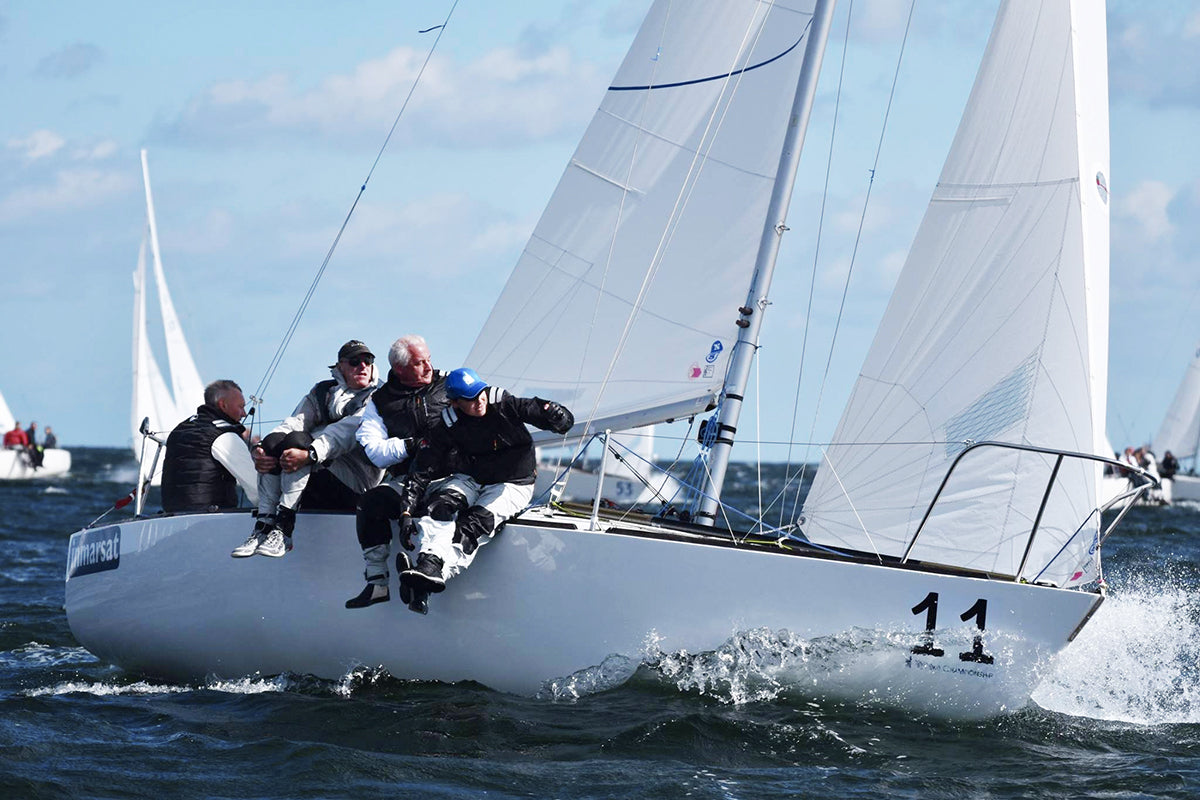
TIPS ON J/24 HEAVY AIR SAILING
TIPS ON J/24 HEAVY AIR SAILING
By Chris Snow
Heavy air is one of those things that makes a lump grow on your throat and a little sweat start building up on your palms. It need not be and in fact the J/24 is a great boat to sail in a breeze. It is one of those unique boats that can be sailed in quite a lot of wind and is very rewarding to sail in strong breeze. At the end of the day you will be tired, a little beat up but you will be grinning from ear to ear.
The following tips apply when sailing at the very top end of the genoa and towards the top end of the jib: 17-19 knots with genoa, and 22-27 knots with the jib.
1
Set shrouds to 31 on lowers and 30 on uppers. Leave overnight and recheck and then re-tighten if needed. Number are for a LOOS Model A tension gauge.
2
Get jib halyard as tight as you can get it. Sail dead downwind, release back stay and get two people pulling on jib halyard. It will be quite tight.
3
Move jib lead back 2-3 holes. No more than that, if you more more than that when you ease the sheet in a puff the lower part of the genoa/jib will be too flat and not have enough power
4
Sail with vang quite tight upwind. Make sure to ease before weather mark or boom could break. Vang will be way too tight for downwind sailing.
5
Sail boat as flat as you can upwind. Feather into puffs. At times you will be sailing on just the back of the genoa/jib and back of main.
6
If whole main is flogging, ease genoa or jib 1-2″..
7
If the boat has too much helm the main is too tight or the genoa is not tight enough.
8
Play the traveler until you have the car just below centerline. Then play the mainsheet.
9
Downwind it is fast to carve down the front of waves and at times sail quite by the lee. To minimize the tendency of the boat to roll to windward and “death roll”, have the tactician (person trimming the spinnaker guy, mast man and bowman to leeward. This will allow you to carve quite deep without feeling like the boat is going to roll over on top of you.
10
Practice, practice, practice….oh yes and then practice.
READ MORE
READ MORE
TUNING BEYOND THE J/24 TUNING GUIDE
TUNING BEYOND THE J/24 TUNING GUIDE
Video Clinics presented by Mike Ingham.
1. LOOKING AT SAILS:
2. APPARENT WIND:
3.MAST SETUP:
4.RIG CONTROLS:
5.JIB HOLLOW:
6.SIDE BEND AND RIG:
READ MORE
READ MORE
NEWS - JULIEN MONNIER, NOUVEAU COLLABORATEUR NORTH SAILS SUISSE
JULIEN MONNIER, NOUVEAU COLLABORATEUR NORTH SAILS SUISSE
Julien à la technique au commercial et au sportif !
Julien, tu possèdes une solide expérience vélique sur à peu près tous les voiliers de compétition. Issu du club nautique de Cully, tu fais tes classes en Optimist et en 470 en passant par le 420 – tu découvres le Surprise au milieu des années 90 et remporte tous les titres nationaux possibles. En 2000, tu rejoins le CER et participe à six éditions du Tour de France à la Voile, les deux dernières en tant que navigateur-tacticien. Maître voilier de métier, tu rejoins aujourd 'hui North Sails Suisse à Genève.
Quel poste vas tu occuper chez North Sails ?
"J'ai un joli et ambitieux cahier des charges, composé de 3 volets : technique, commercial et sportif. Je vais notamment m’occuper de gérer les voiles monotypes telles que Surprise, Esse 850, M2…et le contrôle de qualité de toutes les voiles neuves. Je serai présent sur les plans d'eau pour régater et assister la clientèle et être au plus près des besoins spécifiques de chacun."
Fort de ton expérience à l'internationale et sur les rives lémaniques, tu viens compléter une équipe polyvalente et compétente. Quelles sont les objectifs que tu t'es fixés au sein de North Sails Suisse ?
"North Sails est une voilerie proche de sa clientèle, accordant beaucoup d'attention aux besoins et aux suivis des équipages. Mon but est de découvrir la manière de travailler au sein du groupe North Sails et de continuer à promouvoir et faire évoluer les voiles de monotype et renforcer mon expérience dans ce domaine. Pour atteindre ces objectifs ambitieux, je vais partager mon temps entre le bureau (technique, commerciale, design), le plancher et les plans d'eau."
Parlons bateau..., quels sont tes projets de navigation pour la suite de la saison et la saison 2012 ?
"A vrai dire je n’ai pas encore fixé mes objectifs pour la saison prochaine, mais je termine une saison passée sur des supports monotypes différent tels que surprise, esse 850 et ventilo 28 sur lesquelles nous nous sommes bien illustré avec mes coéquipiers. On a gagné le championnat suisse de surprise, le championnat d’europe en esse 850 et nous somme actuellement en tête du classement général des ventilo 28. Je ne sais pas encore de quoi 2012 sera fait mais j’espère que cette année sera aussi fructueuse niveau résultat que l’est actuellement 2011."
Merci Julien, nous te souhaitons la bienvenue au sein de notre équipe. Tu es maintenant atteignable au 022 782 32 22 ou julien@ch.northsails.com.
READ MORE
READ MORE