
THE WOMEN WHO REDEFINE THE STANDARD, AND THE FORCES THAT MOVE WITH THEM
This International Women’s Day, we honor the women who raise the bar and the collective forces that rise with them.
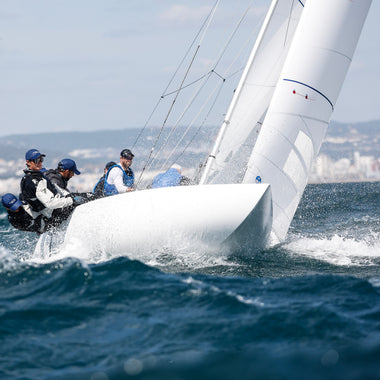
This International Women’s Day, we’re spotlighting a few of the women within our North Sails and North Actionsports communities who are raising the bar – and the teams that stand with them. From late‑night gear prep to early‑morning briefings, from quiet wins to major milestones, from setbacks to breakthroughs, their journeys are built on effort and shared belief. Behind every woman who forges ahead and dreams bigger is a constellation of people moving with her. Not out of necessity, but by intention – because she’s built a team that believes in her vision as fiercely as she does.
To the friends, families, mentors, competitors – to the crew that shares in every victory, we move because you do.
ELLIE DRIVER: THE AUDACITY TO DREAM
“The race isn’t over until it’s over. And believing in someone can be the thing that carries them further than they ever imagined.”

Ellie grew up in Worcester, far from the sea where sailing isn’t something you stumble into. But every August from the age of seven her world shifted north – to Trearddur Bay Sailing Club in North Wales, a community that comes alive for one month a year. That’s where Ellie learned to sail an Optimist dinghy. What began as a summer holiday ritual slowly became the centre of her life. Ellie moved through the British youth sailing pathway, from Optimists into the 420 class.
When international racing paused during Covid, Ellie began sailing with her dad who, having always sailed recreationally, wanted to spend more time on the water. They bought a SunFast 3300 called Chilli Pepper and began learning how to sail double-handed offshore. It wasn’t planned as a career move, but that changed quickly. Before long, Ellie decided she was going to be a professional offshore sailor and her dad, always her biggest fan and committed chauffeur, was coming along for the ride.
One race in particular stands out. During the Morgan Cup, they found themselves neck and neck with Shirley Robertson and Dee Caffari in challenging conditions. They had a brand new North A4 kite onboard, delivered only days before, and Ellie called for it to go up. Her dad didn’t argue and for twenty minutes he said nothing at all, simply trusted the call, grinding and easing as the boat stayed right on the edge. Chilli Pepper crossed the line first on corrected time, winning by eight seconds. Soon after, Ellie became the youngest skipper to complete the Round Britain and Ireland Race and was named Yachts & Yachting Sailor of the Year.
But in true Ellie spirit, she was dreaming of what came next. Growing up, she always admired Ellen MacArthur, and later, Pip Hare. Slowly, the idea formed – The Vendée Globe, solo, around the world. Saying it out loud was difficult. Ellie knew she was still inexperienced, still learning, and when she shared the ambition beyond her closest circle, the response was often hesitation rather than encouragement. It made her question whether the dream itself was misplaced.

Everything shifted when she joined The Magenta Project and was given Annie O’Sullivan as her mentor. Ellie shared her goal and Annie didn’t even blink – “Vendée Globe 2032,” she said, “this is how we’re going to get you there.”
It was the first time someone outside her family had approached Ellie’s ambition structurally rather than symbolically – not with praise or reassurance, but with a plan. That seriousness changed Ellie’s relationship to the goal. It gave her confidence, not because the path was easy, but because someone she respected believed it was possible.
The next step required another kind of commitment. Along with Ollie Hill, a fellow professional English sailor, Ellie moved to France where offshore sailing thrives, and where the Figaro circuit forms the backbone of nearly every Vendée Globe campaign. She left behind her family, her support network, and the familiarity of home, trading it for a new country, a new language, and a much narrower circle of people to rely on. But her parents remained constant, always there, following races, tracking progress. Flying to starts and finishes when they could. Never asking her to be more cautious.
Her mum has taught her to reset when things aren’t going well, to understand that offshore racing, like most things worth doing, is never decided in the first hour. Her dad, to recognize capacity, to know when to push and when to wait, to understand that endurance is as much about judgment as it is about determination.
Ellie is still early in her journey as her Vendée Globe is years away. But her story isn’t about singular brilliance or defying odds. It’s about the systems that make her progress possible – the people who show up for her, who take her ambition seriously, who hold the line when doubt sets in.
Ellie’s story is about the importance of mentorship, of people who believe in you and give you the audacity to believe in yourself. And a mum to remind you to be brave, to be very very brave.
FRANCESCA CLAPCICH: BUILDING AN ARCHITECTURE OF BELONGING
“Representation is everything. You have to see it to believe you can be it.”

“It’s funny,” Francesca, CEO and Skipper of Team Francesca Clapcich Powered by 11th Hour Racing, says, “because people often ask if the team specifically hires women. We don’t. We run an open process and choose whoever is best qualified, it just so happens that many of them are women.” For Francesca, the goal has never been to build a ‘women’s team’ as a symbolic gesture. Instead, her team is living proof that when bias is removed, women earn their place on the boat and in the shed alongside the men in her crew. It is a perspective forged by a career that exists today because people believed in her talent and opened doors in a male-dominated sport.
Francesca grew up in Trieste, Italy, where the pathway to professional sailing – especially for women – isn't well-paved. In fact, sailing wasn’t her first obsession; she spent her childhood in the mountains, with posters of champion skiers tacked across her walls. It was only when her father became ill and could no longer drive her to the mountains, that she looked elsewhere. Ever since she was small, Francesca had always been adamant: no matter the sport, she would go to the Olympics. Her home was on the coast with a sailing club just down the road, so sailing it was.
She did exactly that, winning World and European titles and competing in both London and Rio Olympics. But as her male counterparts began receiving calls from offshore teams, Francesca’s phone stayed silent. In Italy, the ‘big boat’ pathway for women wasn't just narrow; it was non-existent.
Her break finally came from the ‘Turn the Tide on Plastic’ team, who were prepping for The Ocean Race 2017-18 and wanted Francesca to join the crew. “I probably wouldn't be here if I hadn't had that call,” says Francesca. Turn the Tide on Plastic built the only 50-50 gender split team at the The Ocean Race that year, and in doing so opened a door that had previously not existed. Importantly, every single person on that boat deserved their place, regardless of their gender.
Today, Francesca has her own project. As she prepares for her 2028 Vendée Globe campaign alongside title sponsor 11th Hour Racing, she is using her platform to pay forward the support she was once given. Based in the offshore hub of Lorient, her project provides the structure that was missing for her – inviting young women to intern at their HQ to upskill for a professional future, and perhaps one day build their own architecture of belonging, with their own crew to support them.
Francesca has worked tirelessly to surround herself with a team that believes not only in her dreams, but in the mission of building pathways for others. She has transitioned from a competitor seeking a gap in the fence to a leader building a gate, and now Francesca and her crew are holding it open for others. “It’s funny how important representation is for your dreams, it’s everything. You have to see it to believe you can be it.”
CAPUCINE DELANNOY: DEFINING HER PATH
“My brother competes, and for a while I was just ‘the sister.’ But it was more of a motivation to prove I can make my own name, that I’m not only the little sister. I won my first title when I was 15, and he was there. He always is.”

When Capucine arrived on the GKA Kite World Tour, she was 12. To the judges and the other riders, she was simply Camille Delannoy’s sister, but it was a title she carried happily. Capucine had spent her childhood following Camille’s lead. When he took up skiing in the French Alps, she was right behind him. When the family moved to Brazil and the snow was replaced by salt water, she followed him onto a kiteboard.
During lockdown, Camille was landing triple rotations whilst Capucine was perfecting her single rotation. But Camille always treated her as an equal, a competitor. He pushed her to find her edge, not because she was his little sister, but because he knew what she was capable of.
For Capucine, her family has always been her support structure – pushing her forward, always standing by her. With her father as her coach, and her brother on tour as her competitor and biggest fan, Capucine won her first world title at 15. She won her second at 16. It seemed she was unstoppable, until, for the first time, she eased off her training. That’s when things started to change – she lost two world titles in a year. It was a hard pill to swallow and Capucine found herself struggling to get back out there. Her parents never forced her to pick up the kite; they simply waited, and when she finally told her father she wanted to return, he responded, “I won’t go easy on you. You can be the best, and that is what we are going to do.” It was hard for her mum to watch, “she was so young at the time, but I never ever doubted her.”
In the professional world Capucine has to be a tough competitor as, being 19, she is much younger than the rest of the field, most of whom are in their 30s. Additionally, days on tour can be lonely, the constant travel and hotel rooms make it hard to find consistency and community. But Capucine is lucky that she often doesn’t have to travel alone as her brother is by her side. He stands on the shoreline watching her prove she can do it alone, but as a constant reminder that she never has to.
Greatness isn't a solo act. It’s an engineered one.
Capability is the starting line. But the finish line is reached through the systems that sustain us, the mentors who build the plan, the family who steady the waters, and the technology that holds its shape when the pressure mounts.
At North, we design our products to be resilient, precise, and built to perform because you need systems that you can trust.