DESIGNING VICTORY: NORTH SAILS AND THE XR 41
Inside the science, strategy, and sailmaking that delivered a flawless season.
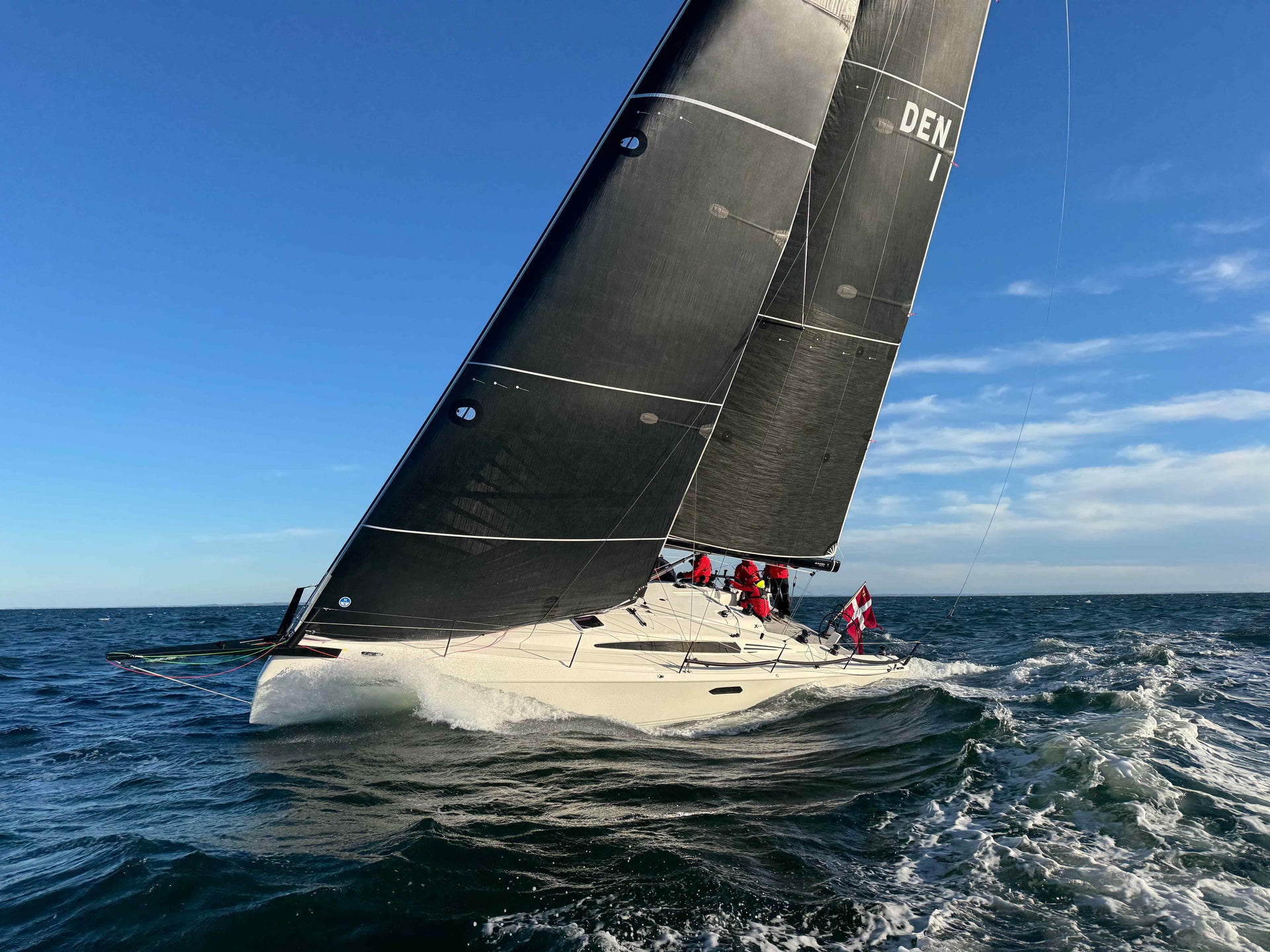
Officially launched in January 2025, the latest boat from X-Yachts has had an extraordinary year. Skippered by Jesper Radich – with many up-and-coming Danish crew onboard – the North-powered, XR 41 Formula X had a stellar season. They won every regatta they entered, culminating with a victory at the 2025 ORC World Championships in Tallinn, Estonia.
“I'm always happy to work with North,” said Radich, “having the strongest tools, and having some of the best designers. I was really happy with my collaboration with Chris Williams.” Williams was the North sail designer for the XR 41, and he brought a strong sailing background to the campaign, both in TP52s and ORC racing.
“North is really good about letting us get out sailing and racing with our clients,” commented Williams, “and I think that's really important for me to fully understand, not just what our sails look like, but how they're used. It's one of the things that I spent a lot of time on for this XR 41 project; really trying to understand what was going to be the best way to tune the rig and the sails, before we even built any.”

The X-Yachts brief for the new boat rested on three pillars. “We wanted to have a boat that is fun to sail, and not just upwind,” explained X-Yachts CEO, Kræn Nielsen. “X-Yachts are very well known for upwind performance, and it was part of the brief to be first at the windward mark in [ORC] Class B. However, we also wanted a boat that was fun downwind. And then in the end, we wanted to have a boat that was significantly faster on the water than on paper [the ORC rating].
“These three things were major drivers in the project, and I think that we have delivered on all three. To reach that goal, the collaboration with the strong external partners was a new thing for us, and, ultimately, the partnership was the difference. We could not have done this ourselves, given the ambition we had for the project,” said Nielsen, adding, “It’s beyond comparison, what North Sails offers.”
The project began with a hull design led by Thomas Mielec of X-Yachts, with Javier Jaudenes of Surge Projects brought in to work on the deck layout and interior. The external partners also included C-Performance's Casper Nielsen CFD specialist and rating expert, and long-term colleague Max Gurgel; data expert with plenty of experience in rating optimization.
“We developed a set of many thousands of hull shapes that we classified as being very strong in the ORC rating,” explained Casper Nielsen. “The big challenge was to find the subset that was also performing nicely on the water and would deliver great fun in various sailing conditions… In the end, we decided on a hull shape that was more fun to sail, rather than outperforming the ORC rating.”

Casper Nielsen had previously worked as a sail designer for North Sails Denmark on America’s Cup and Volvo Ocean Race projects, and now found himself once again working with ex-colleague Chris Williams. “We started out with the baseline mast,” explained Williams, “then we would move the mast aft and keep the tack point of the jib in the same spot, so bigger jibs and smaller main. Then we tried the rig forward with a smaller jib, bigger main. Then we'd try a taller mast and shorter mast. We did all these different parametric iterations to try to understand what rigs were going to be the most efficient. Not just aerodynamically but work best with these potential hull shapes. As far as production boats are concerned, this boat was the first time I've seen this much science put into a project."
“We built the first set of sails and those got looked at in December (2024), and then I went and sailed for a week with the boat in Denmark in January (2025), we refined the sails from there. The changes that we made weren’t too big, from the first set to the final set of sails that were used in the Worlds. Some very tiny dimensional changes to the jib, and we made the mainsail a tiny bit bigger because they had a little space with the rating to play with. So, it was pretty subtle refinements.”
Downwind, the XR 41 performed even better than the team had hoped. “The fun factor is incredible,” said Kræn Nielsen. “The guys, after they won the Worlds, they carried the gennaker to the harbor in 28 knots of breeze doing over 24 knots of speed.”
“We talked about the spinnaker designs and more specifically the areas,” said Williams. “The nice thing about this boat is it does get up and plane early. It's relatively light for a production boat, and you don't need a gigantic, massive spinnaker to get it to the correct sail area to displacement ratio.”
It's the North Design Suite (NDS) that allows the designs to be this refined out of the bag. Following up from the parametric assessment, Williams and the team modelled the rig performance, enabling sail designs to be assessed across the wind range. The performance of each potential design was predicted and optimized for both geometry and structure, using the different elements of the NDS. It was an exhaustive, iterative process.

The team decided on a very all-purpose inventory. “The intent was for each sail to have a very broad crossover,” explained Williams. “In these ORC race formats where you have two distance races, you really don't want to be trying to change sails during the middle of a 20-mile beat. And so, we made sure that the sails were structurally strong enough to be pushed up the ranges, or deep enough and versatile enough so that they could be pushed down the ranges when needed as well.”
One innovation was a structured luff mainsail. “We don't have the luxury of a light and heavy air mainsail with this boat,” said Williams. “So, we wanted to have a main that was deep and powerful enough to get the boat heeled over and get the crew on the rail as early as possible, but still be able to flatten it out in a breeze.
“We put a hydraulic Cunningham system onto this boat and used that to flatten the main out, while also keeping the draft forward in those breezy conditions. We were able to design a deeper, rounder main for the light air performance, and then basically use the helix luff structure to flatten it out and keep the draft where we wanted it once the breeze came on,” he explained. X-Yachts CEO, Kræn Nielsen was impressed. “It’s the lack of stress in these sails, keeping their shape having done regattas in 30 knots of breeze that’s incredible,” he said. “The capability to keep your sail shape on this sail, compared to other sails. That’s the most interesting part of 3Di.”
A group of elite professional sailors – Bouwe Bekking, Jesper Radich and Jens Christensen – were available to share their practical experience with the project. Jesper Radich also stepped up to take charge of the sailing program as skipper. Together with Kræn Nielsen, Radich created a plan to develop young talent in Denmark, eventually taking seven sailors from recruitment sessions that worked with over 30 young people.

“It came to me as a surprise, the amount of international interest,” said Radich. “I remember the first regatta, the MaiOR Regatta in Kiel, and I had journalists from four different countries coming at me just before the start asking how certain I was that we would win the [ORC] Worlds. We’d never raced the boat against anyone. We hadn't even done a lineup… It put a lot of stress on the team.”
The team responded in the best possible way, sweeping all before them. “All the pressure, all the external pressure was completely gone inside the team. We were just, from a very early stage, we were a really, really strong package,” said Radich.
The success builds on a reputation that X-Yachts began more than forty years ago. “X-Yachts had a history of building championship boats in the eighties and nineties, winning in the One Tonners and Three-Quarter Tonners,” said Nielsen. “So, our DNA is certainly there, but over the last 17 years we haven't really built a race boat, not since the X 41.
“Many of our clients had been asking for it [a new race boat]. It was a big request from the market… demonstrated by the twenty-five XR 41s that we have now sold,” continued Nielsen. “The Chairman [Ib Kunøe] and I made a bold statement 24 months ago that we would like to get back to the racing scene and win the World Championships… and delivering on that was definitely a big relief for me.
“We had guys on board that were there twenty-years ago, the last time we won a World Championship. So, getting back into that, that's brought quite a few smiles… a lot of happiness in the company, getting back to our roots.”