
LIFT FROM THE FOIL, POWER FROM THE SAIL
Evolving sail design for the foiling era from the America’s Cup to action sports.
This month at Foiling Week, hundreds of boats will lift off the surface of Lake Garda and start to fly. The fastest of them are the International Moths – eleven-foot dinghies riding on hydrofoils. But alongside these are windsurfers, kites – anything and everything that can fly above the water. Whilst this is going on, out on the Atlantic, IMOCA 60s will be running training days on foils, prepping for the next Route du Rhum, and around the world the next generation of America’s Cup boats will be in their full-flight practice racing. The whole top end of the sport is now airborne, and the temptation is to look at the foils. But ask any of the designers building the sails on those boats or the kites for the boards, and they will all tell you the same thing: foiling isn’t just about the foils.

The Introduction of Foiling Demanded Different Sails
A hydrofoil is a wing that flies underwater, working on the same principle as the wing of an aircraft: fluid flows over a curved surface, the pressure difference generates lift. The difference is the medium. Water is roughly eight hundred times denser than air, which is why a foil, no wider than a snowboard, can lift a boat and its sailor (or crew) clean off the surface. Once the hull is out of the water, the drag that was holding it back all but disappears; the same sail power suddenly produces far more speed. That is what a foil does – it doesn’t push the boat forward, it removes the resistance. "The foils govern the ride height and stability, but the sail is the power plant that’s driving everything,” says Steve Calder, North Sails designer.
The advent of foiling has a paradox built in. Once a boat lifted off the water's surface, the faster it goes, the more apparent wind it generates, and the harder its sail has to work. Across every class that started foiling, the same problem appeared: the sails that worked on the older, slower boats no longer worked on the new, faster ones. Faster boats led to increased aerodynamic drag, so sails needed to be flatter to cut through the wind the boat was now generating, whilst keeping the high lift and power. They also needed to be stronger to survive increased loads and be able to change shape faster between upwind and downwind modes.
As the boats were getting faster the sails had to keep up.

Foiling and the America’s Cup
When foiling debuted at the 2013 America’s Cup, boats had swapped their mainsails for rigid wings (the headsails remained 3Di). Although aerodynamically superior, the wings were a logistical nightmare. “A wing is a lot more efficient than a sail,” says Steve Calder, “but the problem was everything else.” It took thirty-five or forty people to stand a wing up, and once up, the boat was permanently ‘live’. America’s Cup teams needed to evolve and find a way to marry wing-like efficiency with a sail that could be hoisted and dropped.
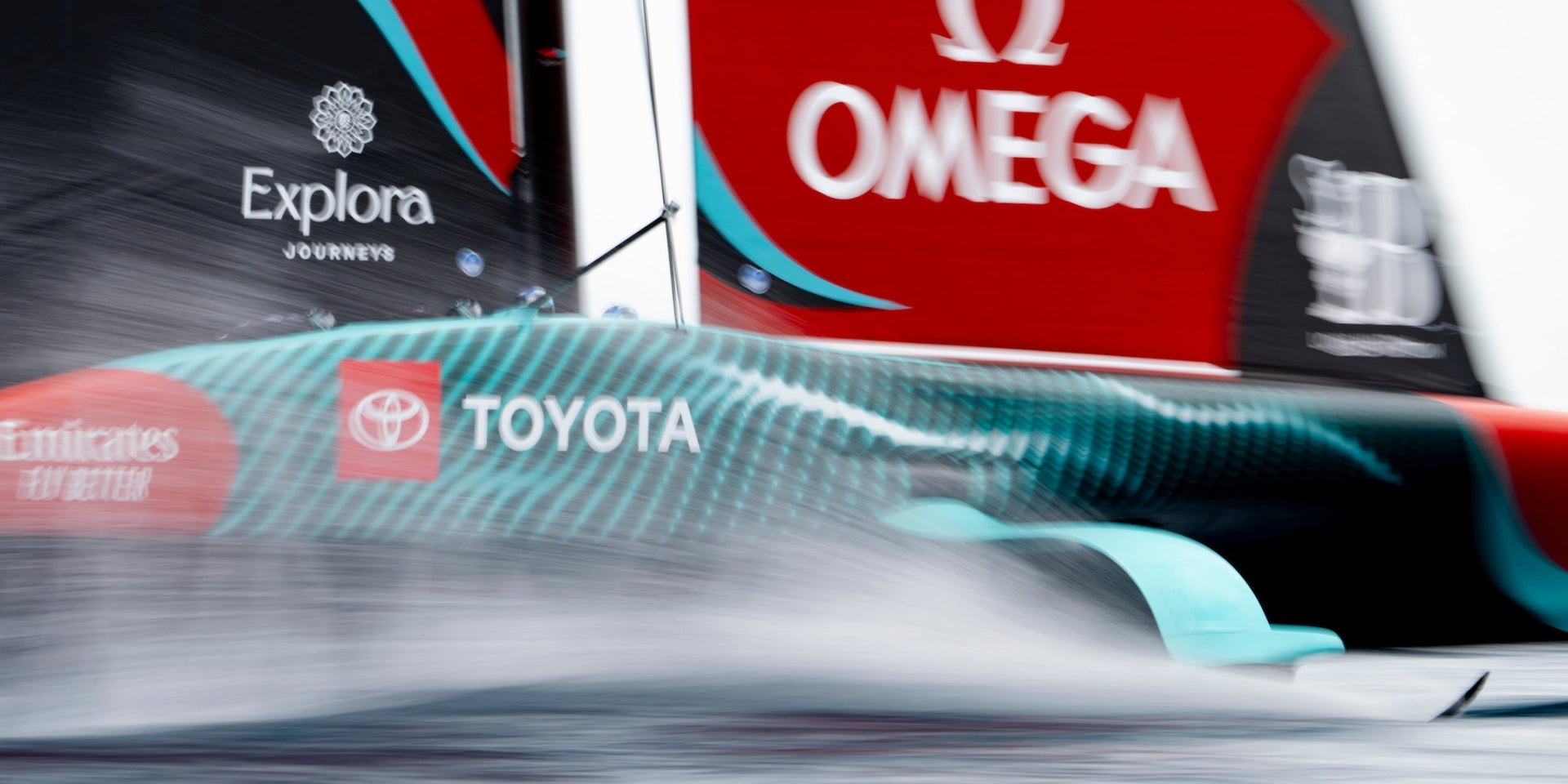
The North Sails twin-skin mains on today's AC75s proved to be the answer: a soft sail built in two surfaces that behaves like a wing in the air and lives like a sail on land. Each skin is a 3Di membrane in its own right; advanced filament tapes formed into a seamless composite structural membrane, engineered for the loads, stresses and strains of the sail’s entire operating range. The two skins are set either side of a D-shaped mast, so the spar becomes part of the structure rather than an obstruction in front of it. Together, mast and skins form a true aerofoil section: a faired leading edge, a cambered profile, and two surfaces that can be trimmed against each other, sheeted, cambered, twisted, to reshape the sail from one gust to the next. That is what made it possible to generate, and control, bigger loads in a soft structure with active systems keeping the rig in equilibrium. "Now you tow the boat out to the race area, and the sails go up and down just like on any other boat,” says Steve Calder.
Although the America’s Cup is the pinnacle of the sport, innovation doesn't only flow one way. “Some of the good innovations in this last Cup have actually come from the Moth,” Steve Calder says. “The flap on the foils. Raking the rig for pitch control.” Which brings us back to an eleven-foot dinghy.

The Moth: Sailing’s Laboratory
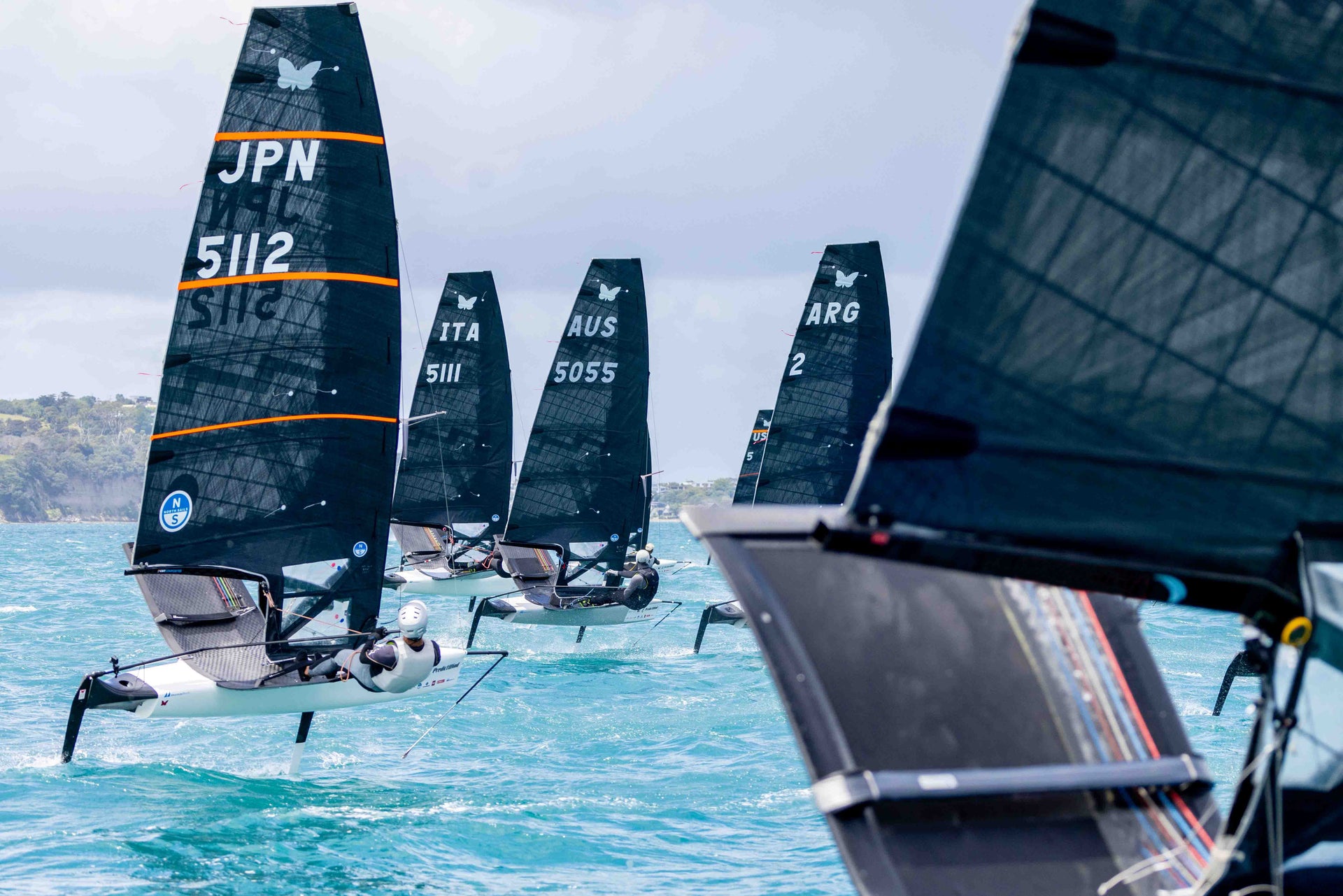
The Moth has been the obvious place to watch this innovation play out. It’s what’s known in the sport as a development class: loose rules with room to invent. When Rob Greenhalgh, International Moth Class Leader at North Sails, first started racing them in 2012, the boats went upwind at 13 knots. Today the fastest of them go at double that, and downwind they reach 30 knots. “The speed evolution has been huge,” says Rob, “and faster boats needed faster sails.”
North Sails’ answer was the Helix Moth, launched in 2022 and built using 3Di. So, what’s unique about it? Something no other sailmaker can do: the sail structure splits in two to encapsulate the mast without using seams.
The leading edge of a Moth sail is the hardest part to get right. It has to wrap around the mast which is an aerodynamic and structural compromise no matter how it is solved. The traditional answer is to stitch a separate tube of fabric, the luff tube, onto the front of the sail, and thread the mast through it. It works, but is weighty and adds undesirable shaping and a turbulent transition between the two components.
But with the Helix, the front of the sail is split rather than stitched. Instead of a separate tube sewn on and threaded over the mast, the membrane itself divides at the leading edge and closes again behind it. So, the sleeve that carries the mast is moulded into the sail as a single piece – no seam, no extra fabric, and none of the turbulent transition that comes with stitching two components together. It is a similar idea, on a smaller scale, to the twin-skin sails on the most recent America’s Cup boats. “The luff tube is just part of it. It creates a super smooth transition from mast to sail,” says Rob. The battens follow the same logic, each one splitting in two at the leading edge to run either side of the mast.
The new 2026 Helix range debuts at Foiling Week: the International Moth Blue, International Moth Orange and International Moth Red. This next-generation of Helix Moth sails represents years of continuous iteration and refinement, setting a new performance benchmark. At the heart of these sails is an optimised 3Di structure and load-path design. By precisely aligning fibre pathways with true load paths, 3Di increases modulus and structural stability with minimal weight gain. The single continuous structure of the sail allows for engineered fibres to follow the true load paths of the boat, providing superior shape control, durability, and consistency across an exceptionally wide wind range.
The structural overhaul of the next-generation sails came from Graeme Willcox, a North Sails designer who worked on INEOS Team UK / Britannia’s recent America’s Cup campaign – bringing fibre-orientation work designed for the loads of foiling America’s Cup yachts down into a single-handed dinghy.

For IMOCAs it Looks a Little Different
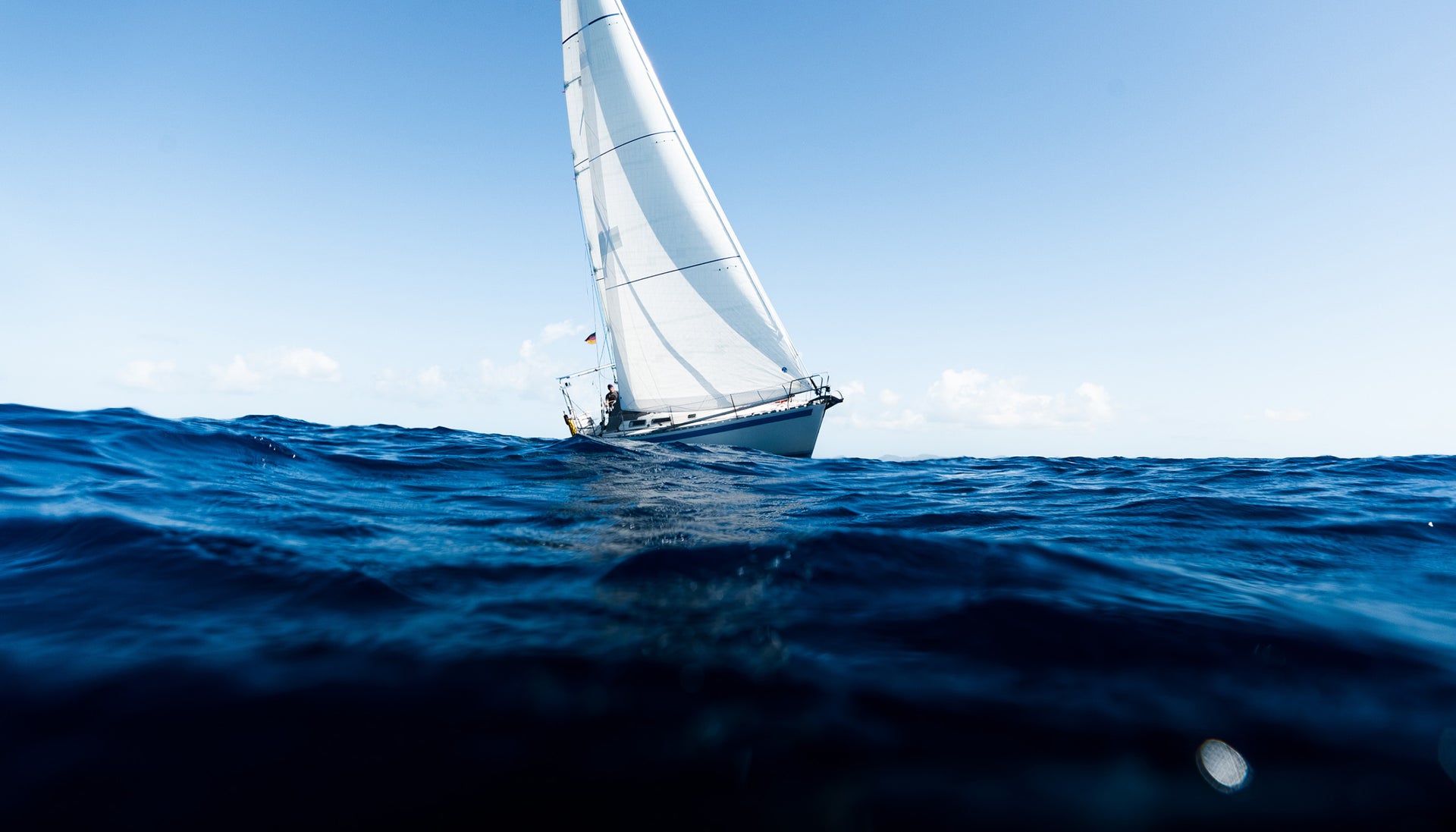
For IMOCAs, the same challenge looks very different. The IMOCA 60s that race around the world have been foiling for the best part of a decade, sustaining thirty knots and more for hours at a time in the Southern Ocean, in conditions that try to break the boat. A Moth sail has to survive a few days of racing, but an IMOCA sail has to hold its shape for weeks at sea, with no spare on board and no loft for thousands of miles. Obviously, the scale is different: a Moth’s mainsail is around eight square metres; an IMOCA’s is more than a hundred, but the biggest difference is in the class rules. IMOCAs aren’t allowed active control surfaces, no flaps, no adjusting the foils’ shape in flight, and no lift from the rudders so the boat flies on the foil and keel alone. “We’re in quite an unstable equilibrium, very different to the Moths and America’s Cup boats,” says Steve Botes, IMOCA sail designer at North Sails. In practice the boat lives in three modes – hull in the water, skimming, fully flying – and the sea decides which, wave by wave. “The boat will be foiling, come off the foils, slam, lose ten knots. The apparent wind angle opens right up, then the boat starts foiling again and it closes down. We need sail shapes that can handle all of that.” It is the exact inverse of the Cup’s problem. “The America’s Cup is about control systems and always having perfect trim. We’re trying to find shapes that are versatile and tolerant to changes in heel, pitch, boat speed and apparent wind angle.”
Foiling made IMOCA sails flatter and generally smaller too. The titanium rings that fix the sail to boat grow with every generation, and the structure of the sail membrane is reworked year on year. The class has also cut the inventory from eight sails to seven, so every shape has to do more jobs – offshore set-ups now run multiple headsails, letting a solo sailor roll one away as the angle changes. The Moth’s split-sleeve trick is off the table here, with a one-design mast and the need for a reefable main, the problem becomes complicated very quickly. Instead, a lot of work is put into integrating the sails as best as possible into the deck and coach roof to provide endplating to clean up the aero drag. But it's the use of 3Di that allows for gains to be made here; no films, no taffetas, nothing extra. “It’s the versatility of the sail shapes and the robustness of the structures,” says Steve Botes. “Tough enough to go around the world and managed by one person. It’s always the fine line between those two.”

The Feedback Loop
The twin-skin concept from the America’s Cup has fed through to action sports, which is undergoing its own foiling-driven acceleration. “Early wings carried a single skin, the racing wings now run a canopy on each surface of the profile, so the riders get flying earlier, in less wind, with better upwind and downwind ability” says Fabian Muhmenthaler, Foil Product Manager at North Action Sports. It's the same twin skin idea, just scaled down to something you can carry under one arm. “Foiling in the sailing world pushed all the engineering and development to the next level, the same has happened here,” he says. “Since foiling came in, we’ve adopted an F1 mentality. The lightest toys, the stiffest sails, the stiffest foils, the best-performing products.”
Across all the classes, the introduction of foiling pushed innovation in sail and kite design to a new level. Each class undertook this challenge in their own context, but advances made in one class bled across to others. North Sails works across every part of the feedback loop; from the kite being rented on a Friday afternoon to the wing on the next America’s Cup yacht. The Moth tests an idea. The America’s Cup proves it under extreme load, IMOCA refines it for weeks at sea within strict parameters, and action sports puts the same engineering in the hands of someone learning at the weekend. Each one feeds the others. This month on Lake Garda, the spectacle will be the foils. The story, as ever, is in the sails.
📸: SAMUEL CÁRDENAS